

Kintsugi Philosophy for Women: What It Means, What It Doesn’t, and 7 Practices to Try
The most repeated origin story of kintsugi begins with a bad repair. In the late 1400s, the story goes, the Japanese shogun Ashikaga Yoshimasa sent a cracked Chinese tea bowl back to China to be fixed. It came home held together with metal staples. He disliked the look, and Japanese craftspeople went looking for something better.
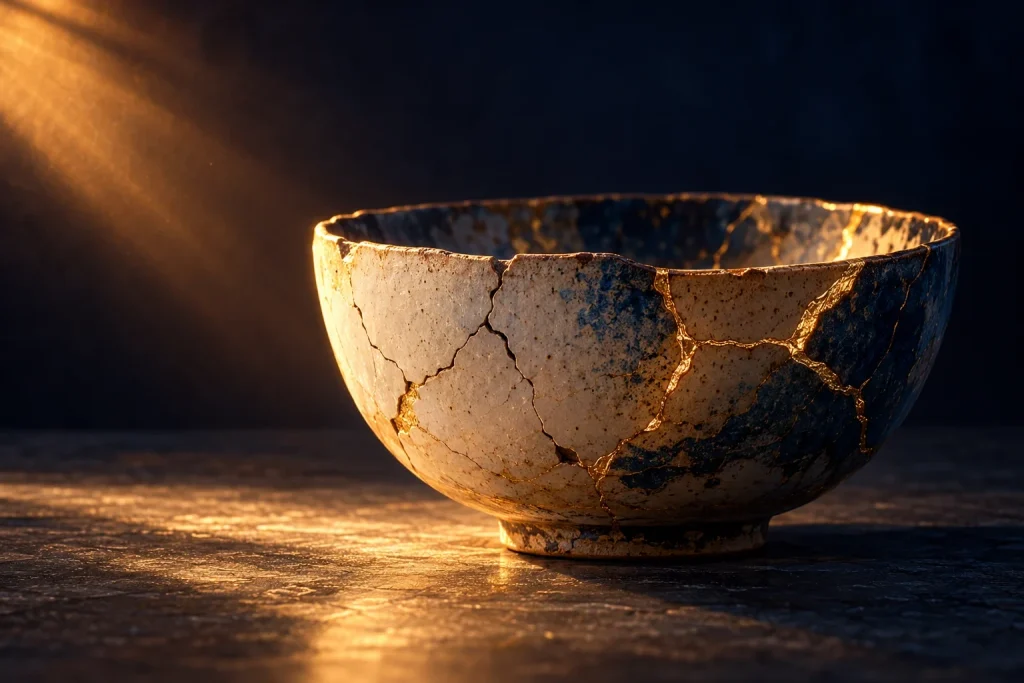
Short answer: Kintsugi (金継ぎ) is the Japanese art of mending broken ceramics with lacquer and powdered gold, so the cracks stay visible. As a philosophy, it treats breakage and repair as part of an object’s history instead of something to hide. For women, the useful part is permission: you can be repaired without being restored to flawless, and you don’t owe anyone a performance of being fine. The risky part is turning that idea into one more thing you have to do well.
Also Read :- https://kheltechie.in/japanese-journaling-for-mindfulness-guide/

Where Kintsugi Comes From, and How Much of the Story is Legend
Nobody knows for certain. Britannica calls the origin unknown and says it is unclear how much of the Yoshimasa tale is true. What it does point to is timing: kintsugi didn’t become widespread until after the 15th century, around the time the Japanese tea ceremony was taking shape and tea masters were learning to prize simple, irregular, aged objects over flawless ones.
By the early 1600s the technique was common enough to be gamed. Smithsonian curator Louise Cort, quoted by My Modern Met, notes that a Japanese warrior became infamous for buying ordinary tea bowls, breaking them, and repairing them in gold to make a profit. Keep that detail in mind. It matters in the section on what kintsugi doesn’t mean.
The craft itself uses urushi, a lacquer made from tree sap, mixed with powdered gold (silver or platinum also work, according to Veltra’s Tokyo guide). Britannica adds that it was applied to Chinese and Korean ceramics, not only Japanese pieces. The word is usually translated as “golden joinery”; some writers prefer “gold repair.”

Kintsugi, Wabi-Sabi, and the other Japanese Words People Mix up
Articles on this topic tend to treat these terms as interchangeable. They are neighbors, not synonyms.
| Term | What it means | How it connects to kintsugi |
|---|---|---|
| Kintsugi | A repair technique that highlights cracks with gold lacquer | The physical practice. The other four are ideas around it. |
| Wabi-sabi | An aesthetic that finds beauty in imperfection, age and incompleteness | Kintsugi is often described as wabi-sabi you can see. |
| Mono no aware | A gentle awareness that everything passes | Explains why a break is expected, not shocking. |
| Mottainai | Regret at waste; the habit of using things fully | Explains why mending beats throwing away. |
| Gaman | Enduring hardship with patience and dignity | The patience in kintsugi draws on it. |
The definitions follow Veltra’s guide. One caution, and it’s my own opinion: be selective with Gaman. Patient endurance is admirable until it means putting up with something nobody should have to put up with. Kintsugi leans the other way. Someone looked at the damage, took it seriously, and did the slow work of repairing it.

What Kintsugi Offers Women Who are Tired of “Having it together”
Psychologists Thomas Curran and Andrew Hill pooled 164 surveys covering 41,641 college students in the US, Canada and the UK between 1989 and 2016. About 71% of the participants were female. All three types of perfectionism they measured went up. The biggest jump, 33%, was in socially prescribed perfectionism, the feeling that other people expect you to be perfect (American Psychological Association summary).
The trend held after controlling for gender, so this is not a women-only problem, and the study covered students, not all adults. Still, it describes a pressure plenty of people recognize: the sense that an audience is watching and keeping score.
Kintsugi sends the opposite signal. The repair is the most visible part of the object. Nothing is covered up, and the object is kept anyway.
You can see women reaching for the idea in different places. Chantel Cohen, a licensed clinical social worker writing for HealthyWomen, uses kintsugi as a frame for couples repairing a relationship after a rupture. A mended relationship won’t match the original, she says, much like a crumpled sheet of paper that has been smoothed flat. A first-person post on the Health Hour Therapy blog, from a Nairobi counseling practice, ties the idea to early motherhood alongside a magistrate’s career, a divorce, and going back to school for two master’s degrees. Veltra’s guide applies it to career setbacks and the end of relationships.
None of these are controlled studies. They show where people reach for the metaphor: relationships, work, and the feeling of not measuring up.

Why “Bouncing Back” is the Wrong Picture
Resilience is a physics word. In materials science it describes how well something returns to its original shape after being bent or hit. Author and coach Céline Santini points out on her site that psychology borrowed the word, and that the borrowing misleads: people don’t return to who they were before.
A repaired bowl doesn’t either. It’s a different bowl with a visible history, and it can go back into use. The “bounce back” picture sets a quiet trap for anyone recovering from a breakup, a job loss or a hard year: if you aren’t back to normal by spring, you’ve failed at recovering. The kintsugi picture has no “back.” There is the break, the repair, and what you do with the object afterward.

Kintsugi Outside the Pottery Studio
Los Angeles artist Victor Solomon used the idea at public scale. His project Kintsugi Court took a fractured public basketball court in South Los Angeles and repaired it with gold-dusted resin, as noted in Wikipedia’s kintsugi entry. A court is built to be used, which makes the point: repair isn’t meant to take a thing out of circulation.
What Kintsugi does not Mean
⇝ It does not mean the pain was worth it
Gold on a crack doesn’t prove the break was a good idea. Post-traumatic growth research, the closest thing psychology has to this metaphor, is explicit about that. The term was coined in the mid-1990s by psychologists Richard Tedeschi and Lawrence Calhoun at UNC Charlotte, and their 2004 paper stresses that growth often exists alongside ongoing distress, and that traumatic events are not to be seen simply as the beginning of growth. Even Santini, who runs kintsugi workshops, writes that kintsugi does not glorify pain.
⇝ It does not promise you’ll come out stronger
Tedeschi has said plainly, on the American Psychological Association’s Speaking of Psychology podcast, that not everybody experiences post-traumatic growth, and that losing support can get in the way. Some people grow in one area and not another. Some people get through it, and that counts.
⇝ It is not a performance
The social media version of kintsugi is a gold-veined bowl and a caption about healing. That’s the warrior with the tea bowls again: gold cracks became a look, and a look can be faked. If you feel you must display your repair to prove you’ve recovered, that’s perfectionism coming back in a prettier outfit. A private repair is still a repair.
⇝ It is not treatment
A metaphor can make a hard stretch easier to talk about. It can’t replace a licensed therapist or doctor if you’re struggling to function, sleep, or feel safe. If you’re in the US and in crisis, you can call or text 988 at any time to reach the Suicide & Crisis Lifeline.
7 Kintsugi Practices to Try
These adapt ideas from the research above and from the practical tips in the HealthyWomen and Veltra pieces. They are ordinary journaling and conversation exercises, not tested protocols and not clinical treatment. You need a notebook. Number 7 is optional and the only one that costs money.

1. Write the break as plain facts (10 minutes)
Pick one thing that cracked: a layoff, a breakup, a failed exam, a year that went sideways. Write five sentences about what happened and only what happened. A format that works: the date, who was involved, what was said or decided, and what changed afterward. Leave out verdicts like “I ruined it” and spin like “it was all for the best.”
Why bother? Kristin Neff, the psychologist behind much of the research on self-compassion, describes mindfulness as keeping painful feelings in balanced view, neither suppressed nor exaggerated (self-compassion.org). Facts-first writing is a practical way to do that. You can’t exaggerate a calendar date.

2. Do the three-line self-compassion break (3 minutes)
Neff’s self-compassion break has three steps, each tied to a part of her model. Say them silently or out loud:
- “This is a moment of suffering.” (mindfulness)
- “Suffering is part of life; other people feel this too.” (common humanity)
- “May I be kind to myself.” (self-kindness)
Use it right after a mistake, not after an hour of replaying it. Cohen suggests a related check: would you speak to a friend this way? If not, rewrite the sentence you just said to yourself. It feels awkward at first. Try it five times before deciding it isn’t for you.

3. Name your gold, if there is any (15 minutes)
Tedeschi and Calhoun describe five areas where people report growth after hard events: appreciation of life, relationships with others, new possibilities, personal strength, and spiritual change. Use them as prompts. For each one, write a single sentence on whether it applies to the break you described in practice 1. An invented example: “Relationships: two friends showed up, and I didn’t expect either of them.”
Skip any area that doesn’t fit. Some weeks nothing fits. A crack left plain is allowed.

4. Keep one cracked thing in daily use (no extra time)
Pick a chipped mug, a scratched pan, or a bag with a mended strap, and keep using it instead of replacing it. That’s mottainai in practice. One safety note: if a mug is cracked through or chipped at the rim, move it to your desk to hold pens instead of drinking from it. The goal is a small daily reminder that a flawed thing can stay in service, not a ceremony.

5. Say one unpolished thing to one person (10 minutes)
Choose someone safe and tell them one thing you would normally edit before saying. Cohen’s advice to couples works for friends and family too: say “this was hard for me” instead of assigning blame. After a conflict, she also suggests asking each other “What helped us get through that?” and “What could we do differently next time?” and keeping the answers in a shared note, so there’s a record that you’ve handled something before.

6. Find the audience in your head (15 minutes)
Socially prescribed perfectionism, the term from the Curran and Hill study, means believing other people demand perfection from you. Test it. List the places you feel you have to look fine: work meetings, family dinners, the school pickup line, social media. Next to each, write who exactly expects that.
A named person who has actually said it is one situation. If you can’t name anyone, you may be following a standard you absorbed along the way, and you’re allowed to ask whether you want to keep it.

7. Try real kintsugi, carefully (optional)
If you want the hands-on version, start with a local workshop. The teacher handles the materials, and you can finish a repaired piece in one session. In Tokyo, studios near Shin Koenji and Nippori run English-language sessions, according to Veltra.
At home, know what’s in the kit. Traditional kintsugi uses urushi, and raw urushi contains urushiol, the same oil found in poison ivy. Kit sellers, including Chimahaga and kintsugi-kit.com, warn that it can cause a rash while wet, tell buyers to wear rubber gloves, and say it is considered food-safe only once fully hardened. One seller says its “hypoallergenic” version lowers the risk but doesn’t remove it, and that a proper cure can take weeks to months.
Some beginner kits use epoxy instead. Check whether the manufacturer says it is food-safe, and if it doesn’t say, keep the piece for display. As of October 2026, Chimahaga lists its Basic and Standard kits at $139 and $179 before tax. If that’s more than you want to spend, practices 1 to 6 are the same idea without the lacquer.
Also Read :- https://kheltechie.in/japanese-onsen-ritual-guide/

Where to Start
If you just had a fight with someone close, start with 5. If you keep comparing yourself to other people, start with 6. If you’re in the middle of something raw, do 1 and 2 only, and consider talking to a professional before 3, which asks you to look for growth that may not have shown up yet. If you learn by doing, book the workshop in 7.
Can’t decide? Do number 2 tonight. It takes three minutes.
Questions People Ask About Kintsugi Philosophy
That damage is part of an object’s history and can be shown instead of hidden. In everyday life, people read that as accepting imperfection and treating hard events as part of your story rather than something to erase.
No. Wabi-sabi is a broader aesthetic that finds beauty in imperfection, age and impermanence. Kintsugi is one specific craft that expresses it.
The gold-lacquer technique is Japanese, though it has been applied to Chinese, Korean and Vietnamese ceramics too. The origin legend involves a Chinese bowl, which is partly why people ask.
No. Research on post-traumatic growth stresses that growth and pain can exist together, and that trauma isn’t good because some people grow from it. You can mend something and still wish it hadn’t broken.
It depends on the materials. Sellers of traditional urushi say fully hardened urushi is food-safe. Epoxy-based repairs vary, so check what the maker says. If nobody can tell you, keep the piece for display.
Sources
- Britannica: Kintsugi (origins, timeline, materials)
- My Modern Met: Kintsugi, the centuries-old art of repairing broken pottery with gold (history, Louise Cort)
- Veltra: The Philosophy Behind Kintsugi (wabi-sabi, mono no aware, mottainai, gaman, Tokyo workshops)
- American Psychological Association: Perfectionism among young people (summary of Curran and Hill)
- Curran, T. and Hill, A. P. (2019), Psychological Bulletin 145(4), 410-429
- Tedeschi and Calhoun (2004), Posttraumatic Growth: Conceptual Foundations and Empirical Evidence, Psychological Inquiry
- American Psychological Association, Speaking of Psychology: interview with Richard Tedeschi
- Kristin Neff, self-compassion.org (three components, self-compassion break)
- HealthyWomen: Lessons from Kintsugi, by Chantel Cohen, LCSW (July 2025)
- Kintsugi Spirit: Kintsugi, a Metaphor for Resilience, by Céline Santini
- Health Hour Therapy: Finding Beauty in Brokenness
- Wikipedia: Kintsugi (Kintsugi Court)
- Chimahaga: Basic Kintsugi Repair Kit and kintsugi-kit.com: Kintsugi beginner’s guide (urushi safety, pricing)
Researched and written by Ashish B, who runs Kheltechie (not a doctor or therapist), using the sources listed above. This is general information, not medical or mental health advice. Last reviewed October 23, 2026.