
Japanese New Year Traditions for a Fresh Start: A Dec 13 to Jan 15 Plan for Your Home
Japan starts the year by finishing the old one. In the weeks before January 1, households settle thank-yous, clean the house from top to bottom, put up a few specific decorations, eat certain foods on certain days, visit a shrine, and write down one intention. Most of it works in an American home with small changes. This guide gives you the 2026 to 2027 dates and the US version of every step.
The order matters. Close the year first, then start the next one. That single idea is what separates a Japanese-style fresh start from a resolutions list, and it is why the traditions below come as a sequence instead of a pile of facts.
A note on where this comes from: the guide is built from official Japanese government and library pages and published cultural references, not from a family tradition. Customs differ by household and by region, so the dates here are the common version. Your own plan can bend them.

Why Japan Starts With an Ending Instead of a Resolution
The Japanese New Year is called Oshōgatsu (お正月). Shōgatsu means “first month,” and the o- in front is a polite prefix. It is Japan’s biggest holiday, and it runs as a season, not a single night.
The Western New Year points forward: a countdown, a toast, a list of goals. The Japanese version spends about four weeks pointing backward first. Each year is treated as its own unit, so debts, gifts, grudges and chores are meant to be settled before January. Only then does the new year begin.
Behind the cleaning and decorating is a belief in toshigami, the deity of the incoming year, who is said to visit homes at New Year. You do not have to share that belief to use the traditions. It does explain why the rules are so specific: a clean house, the right decorations at the door, and no sweeping once the guest has arrived.
The date is January 1, the same as in the US. Japan switched to the Gregorian calendar in 1873, and the National Diet Library records that the government announced the change in November 1872 with so little notice that a great deal of confusion followed. Before the switch, New Year followed the lunar calendar, which is why it is a different holiday from Chinese New Year.
The plan below follows six steps: close the old year, clean, welcome the new one, do the “firsts,” set one intention, and close the season around January 15.
The Timeline: December 13 to January 15 (2026 to 2027 Dates)
Here is the whole season in one table. The weekdays are for 2026 to 2027, and the right-hand column is the version you can do at home in the US.
| Date | Japanese tradition | US version |
|---|---|---|
| Sunday, Dec 13 | Kotohajime: the formal start of New Year preparations | Pick your cleaning dates and list the people you want to thank |
| December | Oseibo gifts and bōnenkai “year-forgetting” dinners | Send a short thank-you note or message |
| Dec 13 to 28 | Ōsōji: the big year-end clean | Use the weekend of Dec 26 and 27, after Christmas |
| Monday, Dec 28 | Decorations go up; mochi is traditionally pounded | Set up a simple pine arrangement and wreath |
| Thursday, Dec 31 | Ōmisoka: toshikoshi soba, temple bells at midnight | Soba before midnight, then name what you are finished with |
| Friday, Jan 1 | Ganjitsu: first sunrise, osechi, ozōni, money gifts for children | A slow morning, no sweeping |
| Fri to Sun, Jan 1 to 3 | Sanganichi: the first shrine or temple visit (hatsumōde) | A visit to a Japanese American temple or cultural center, if one is near you |
| Saturday, Jan 2 | Kakizome (first calligraphy) and the first dream of the year | Write your one word |
| Thursday, Jan 7 | Seven-herb rice porridge; decorations come down around Tokyo | Take decorations down if you like |
| Monday, Jan 11 | Kagami biraki: the offering rice cake is broken and eaten | Use up any kagami mochi you bought |
| Friday, Jan 15 | Dondo-yaki bonfires; decorations come down in Kyoto and Osaka | Retire your word paper |
Some dates shift by region. Decorations come down on January 7 around Tokyo and on January 15 in Kyoto and Osaka, and some households keep a slightly different schedule. If your week does not match the table, keep the order and move the dates.

Step 1: Close the old year with the people in it
Before anything gets cleaned, Japanese households tie up loose ends with people. Three customs cover it.
⇝ Oseibo (お歳暮) are year-end gifts sent in December to people who helped you during the year: a boss, a mentor, a doctor, a longtime client. They are usually food or drinks, things that get used up so nobody feels they owe a gift back. Department stores build whole floors for them. It is also the custom younger households skip most, so treat it as optional.
⇝ Bōnenkai (忘年会), “year-forgetting parties,” are the December dinners where colleagues and friends agree to leave the year’s friction at the table. Offices and friend groups book them through the month. For one evening, rank and old complaints are set aside.
⇝ Nengajō (年賀状) are New Year postcards. They are mailed in late December and held by the post office so every card arrives on the morning of January 1. They thank people for the past year and ask for the next one to go well. One rule matters here: a household in mourning sends a notice in November asking people not to send cards.
The practical version at home is a short message to the three to five people who made your year easier, sent before December 31. Handwritten is better if you can manage it, because the whole point is that it is personal. Something like:
“Hi Dana, thank you for covering my Thursday shifts in October. It made a hard month easier. I’d like to return the favor in January.”
That example is invented, but its shape is the useful part: name the specific thing, say what it did for you, and offer something forward. A message like that does the work of both oseibo and nengajō.

Step 2: Ōsōji, resetting the house and yourself
Ōsōji (大掃除), “the big clean,” is the deep clean of homes, offices, schools and temples before New Year. The point is less hygiene than timing. A new year should not arrive into the leftovers of the old one, and in the Shinto tradition the home is cleaned to welcome toshigami.
Temples do it too, at a scale that makes a bathroom scrub look modest. Each December at Nishi Hongwanji in Kyoto, more than 500 volunteers beat the dust out of the tatami mats and wipe the floors and beams by hand, a year-end ritual that dates to the 15th century.
Most households try to finish by around December 28, and many give themselves until about the 30th. Cleaning on New Year’s Eve is seen as rushed. Leaving the cleaning and decorating until that last night has its own name, ichiya-kazari (“one-night decorating”), and it is thought to bring bad luck.
The modern version includes the person, not only the house. Many people replace their toothbrush, book a haircut, buy a new planner or diary, wash the car, clear out the fridge, and sort belongings into keep, pass on and throw away. The thinking is simple: you want to start the year in a space and a routine that feel new. If the sorting makes you ask what you actually want more of next year, finding your ikigai step by step works well alongside it.
If you want a plan that fits the US calendar, Christmas weekend does most of the work. In 2026, December 26 and 27 are a Saturday and Sunday, and December 28 is a Monday.
- Saturday, Dec 26: kitchen and bathrooms, especially the places you only scrub once a year, like the inside of the oven and the shower track.
- Sunday, Dec 27: closets and drawers. Make three piles: keep, pass on, throw away. Drop the pass-on pile at a donation center that week.
- Monday, Dec 28: entryway, windows and front door, then put up your decorations (next section).
- Anytime before the 31st: the personal reset. New toothbrush, haircut booked, planner bought.
One rule to keep: put the broom away on January 1. Japanese tradition says not to sweep on New Year’s Day, because you might sweep out the deity who just arrived. In practice it means the cleaning is finished and the day is for resting.

Step 3: Decorations that welcome the year
Three objects do three different jobs, and all of them go up around December 28.
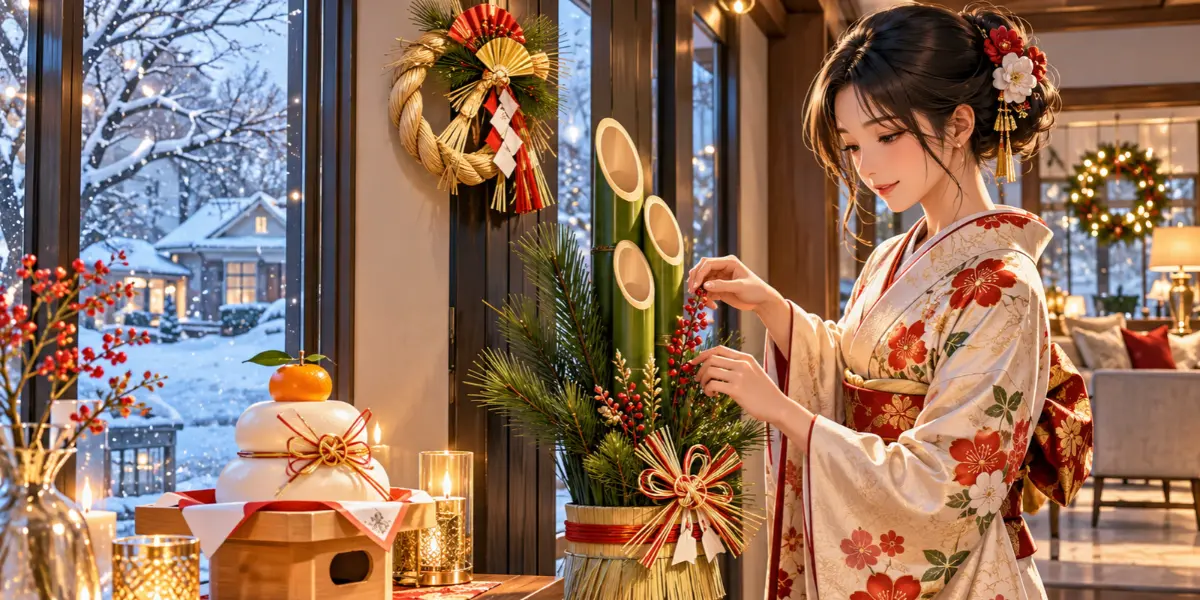
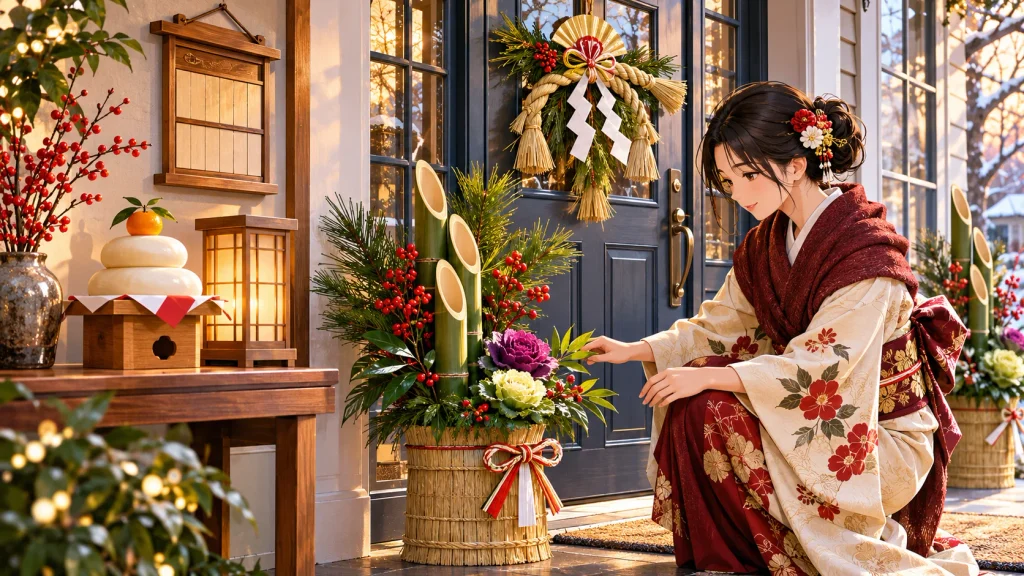
Kadomatsu (門松) are pine and bamboo arrangements set in pairs at the entrance, as a perch for the visiting deity. Shimenawa (しめ縄), or shimekazari, is a twisted straw rope, often hung with paper streamers, placed on the door to mark the space as clean and set apart. Kagami mochi (鏡餅) is two round rice cakes stacked inside the house with a small citrus on top. The name means “mirror rice cake,” after the round mirrors treated as sacred objects in Shinto.
The timing has reasons attached. The 29th is skipped because the number nine sounds like the word for suffering, and the 31st is skipped for the one-night reason above. Mochi pounding, mochitsuki, traditionally falls on the 28th for the same logic.
You do not need all three. A pair of pine sprigs by the door and a small wreath carry the idea. Kagami mochi and shimekazari are sold by Japanese grocery stores and online shops in the US, usually in the weeks before New Year, so order early if you want them. Plenty of households in Japan skip some or all of these decorations, so a simple version is still a real version.
New Year’s Eve: Toshikoshi soba and the 108 bells
New Year’s Eve, Ōmisoka (大晦日), is a quiet evening at home in Japan, not a party. The TV runs a long music show called Kōhaku Uta Gassen, and the food is simple.
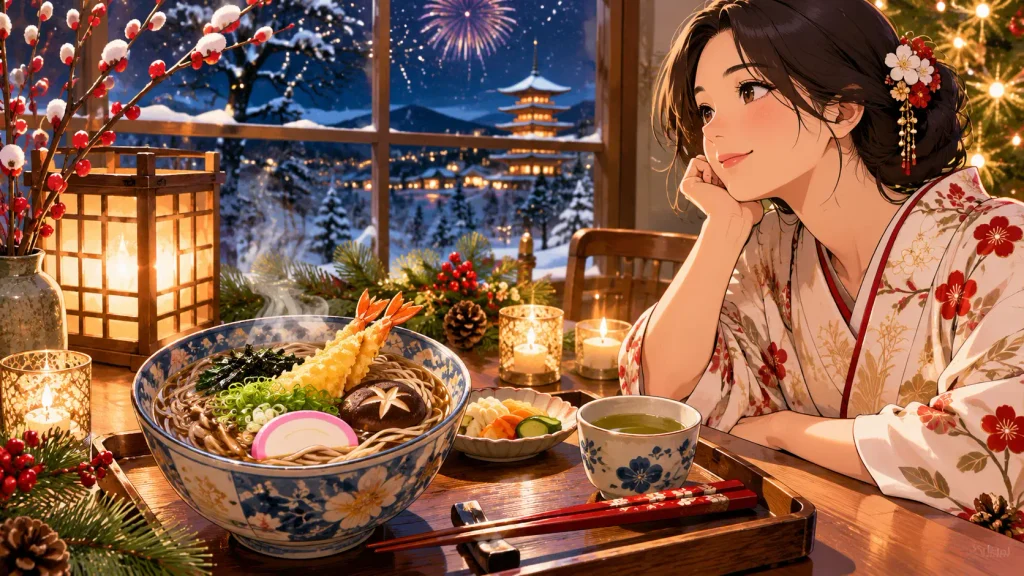
Toshikoshi soba (年越しそば), “year-crossing noodles,” is a bowl of buckwheat noodles eaten before midnight. The long strands stand for a long life, and soba snaps easily when you bite it, which people read as cutting off the year’s troubles. Leaving the bowl unfinished past midnight is said to be bad luck, a superstition people mention lightly.
Near midnight, Buddhist temples ring the bell 108 times, called jōya no kane (除夜の鐘). The number comes from the 108 earthly desires in Buddhist teaching, and each strike is meant to release one. Most temples strike 107 times before midnight and hold the last one until the new year begins. Some let visitors take a turn at the bell.
For the US version, make soba on December 31 and eat it before midnight. Dried soba is easy to find in many grocery stores and Asian markets, and a basic bowl needs only broth and a few toppings. Then borrow the bell’s idea without the bell: take five quiet minutes before midnight and name one thing you are done with. If a Japanese American temple or cultural center near you holds a New Year’s Eve or New Year service, check its calendar, since some do.
New Year’s Day and the First Three Days
January 1 is Ganjitsu (元日), and it is treated as a model for the whole year, so the aim is a calm, tidy, unhurried day. Four customs fill it.
- Hatsuhinode (初日の出) is watching the first sunrise of the year, from a beach, a hill or a rooftop.
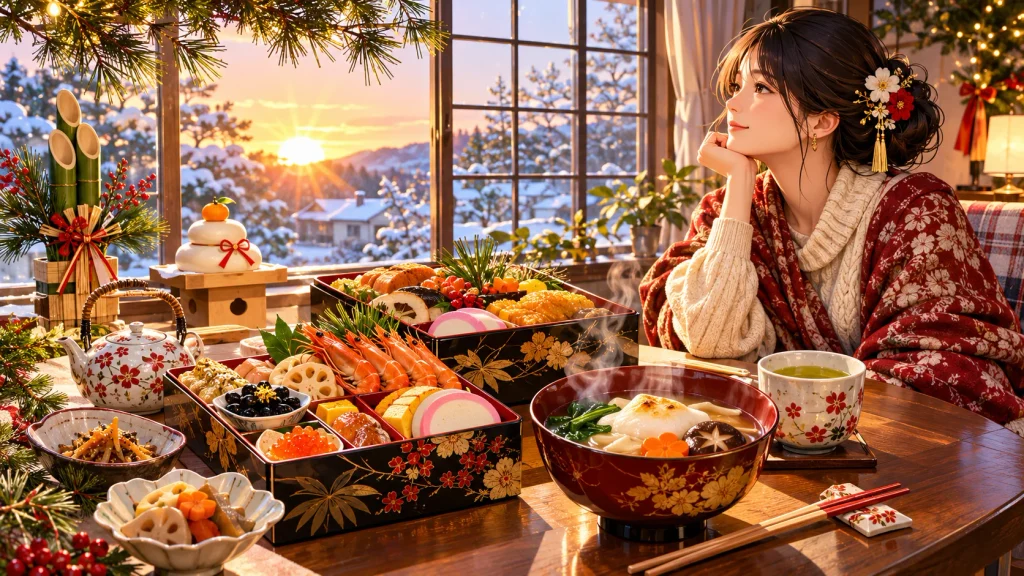
- Osechi ryōri (おせち料理) is a set of cold dishes packed in tiered lacquer boxes and cooked ahead, so nobody cooks over the holiday. Each dish carries a wish: black soybeans for health and hard work, herring roe for many children, shrimp for a long life.
- Ozōni (お雑煮) is a mochi soup and the one hot dish of the morning. It changes by region: clear broth with square mochi in eastern Japan, white miso with round mochi around Kansai. Almost every household has its own version.
- Otoshidama (お年玉) is money for children, given in small decorated envelopes. The amount varies by family and by the child’s age, and there is no fixed figure.
Hatsumōde (初詣), the first shrine or temple visit of the year, can happen at any point from January 1 to 3. It does not have to be at midnight. Big shrines such as Meiji Jingu in Tokyo draw millions of visitors across those three days. People pray for the year, draw a fortune slip called omikuji, and hand in last year’s charms to be burned.
At home, keep the day slow. Eat something made ahead, step outside for the first light if you are an early riser, and call or message family. In 2027, January 1 to 3 falls on a Friday to Sunday, so if you have Friday off, you have the same three-day window Japan calls sanganichi. For a shrine or temple visit, check the calendar of a Japanese American cultural center or temple near you.
How the Japanese Set Intentions, and Why it Differs From Resolutions
Japan has several small customs for setting an intention, and they are scattered across the season. Put together, they make a better method than a resolutions list.
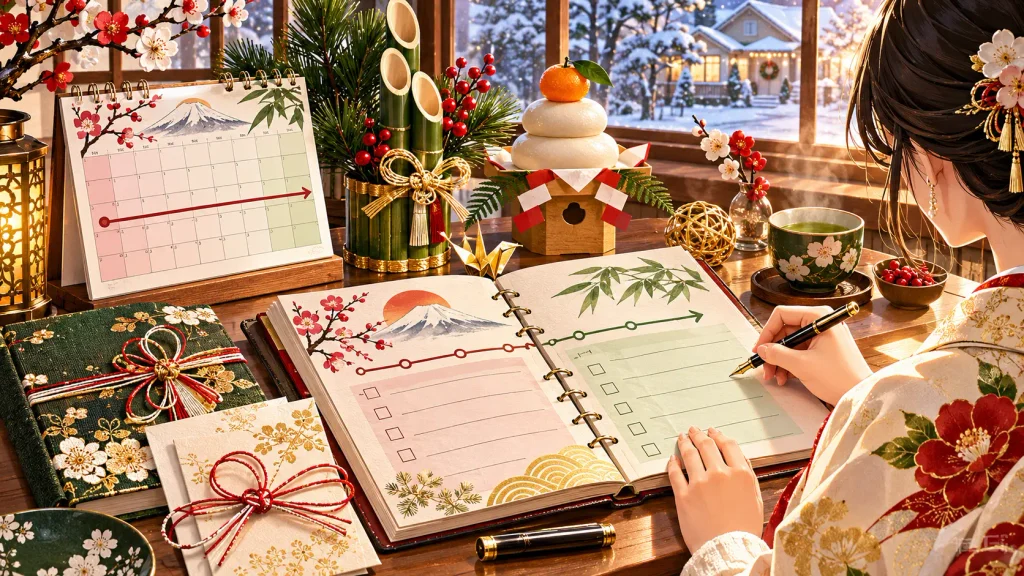
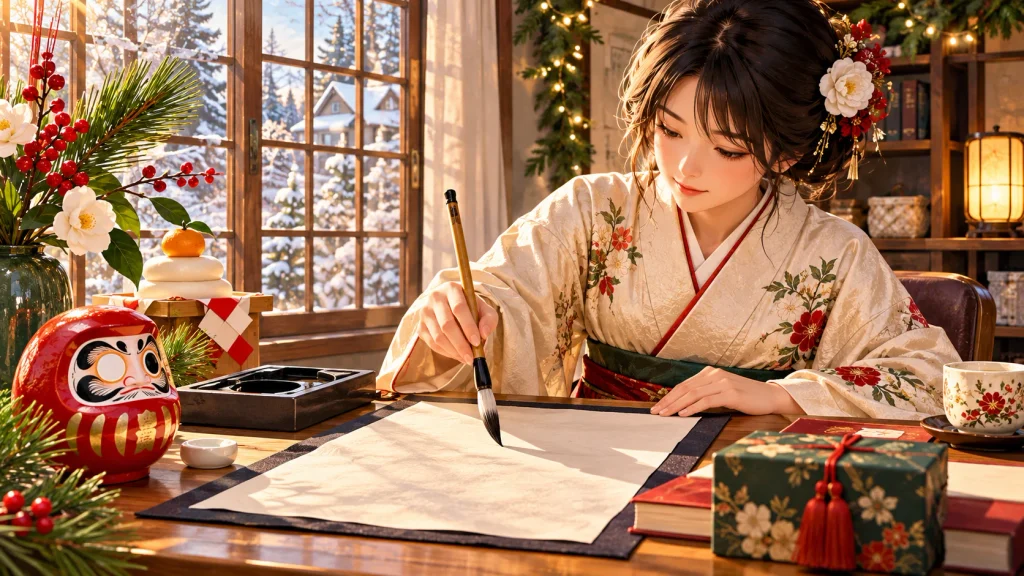
⇝ Kakizome (書き初め) is the first calligraphy of the year, done on January 2. You brush one word or short phrase on paper. People choose words like kansha (感謝, gratitude), kibō (希望, hope) or keizoku (継続, keeping at it). The sheet is kept for a couple of weeks and burned at the mid-January bonfires.
⇝ Daruma dolls work as a goal tracker. You paint in one eye when you set a goal and the other when you reach it. Some people buy one at year-end for exactly that reason.
⇝ Omikuji and ema are the shrine versions: fortune slips drawn at a shrine, and small wooden plaques where visitors write a wish.
Two sayings sit behind all of it. Ichinen no kei wa gantan ni ari means “a year’s plan starts on New Year’s Day.” And many Japanese companies hold a shigoto-hajime, a first-workday ceremony where the year’s goals are announced.
Here is how that translates. Choose one word on January 2, write it by hand, and keep it where you will see it every day until January 15. If you run your own work, treat Monday, January 4, 2027, the first full workday in the US, as your shigoto-hajime: before opening email, write down the one project or habit the year is built around.
A resolution is a target you can miss. A word is something you check your week against, which makes it harder to fail and easier to adjust. That difference is the reason this part of the season fits a US reader so well. If you want a small daily habit to pair with your word, the kaizen method for daily habits is a good next read.

Which Traditions Work in the US
Not everything travels. This table sorts the traditions by how realistic they are outside Japan.
| How easy | Traditions | What it takes |
|---|---|---|
| Easy at home | Ōsōji reset, thank-you notes, toshikoshi soba, a one-word kakizome, a slow January 1, the January 15 close-out | A weekend of cleaning, a pack of soba, a pen and paper |
| Possible with effort | Kagami mochi and shimekazari, osechi boxes, a New Year event at a Japanese American temple or cultural center | Ordering ahead from a Japanese grocer or online shop, and checking local calendars |
| Mostly Japan only | Hatsumōde crowds at the largest shrines, fukubukuro lucky-bag sales, the Kōhaku TV show | Being there, or enjoying them from a distance |
A few lines on borrowing respectfully. The home customs, meaning cleaning, thank-you notes, soba and a written word, are cultural and secular, so anyone can use them. Shrine and temple visits and the bell are religious settings, so follow posted rules and learn what each action means before you do it. And use the real names and meanings. Presenting a ritual as a productivity hack is the quickest way to get it wrong.
Mistakes and Taboos to Avoid
- Sweeping on January 1: The saying is that you sweep out the deity who just arrived. Finish the cleaning before the 29th and rest on the 1st.
- Decorating on December 29 or 31: The 29th sounds like “suffering,” and the 31st counts as last-minute. Use the 28th, or the 30th at the latest.
- Cleaning in a rush on New Year’s Eve: It is seen as rushed, and the idea is to be done early enough to enjoy it.
- Saying “akemashite omedetō” before the year turns: The greeting, roughly “congratulations on the new year opening,” starts on January 1, not before.
- Cutting the kagami mochi with a knife: It is broken with a mallet on January 11, because cutting suggests cutting ties.
- Assuming December 29 to January 3 are national holidays: Under Japan’s Act on National Holidays, New Year’s Day, January 1, is the holiday. Many businesses close for several days around it, but that is custom and varies by employer.
- Eating mochi too fast: The Tokyo Fire Department notes that choking accidents involving mochi rise every year from December to January. Its advice: cut mochi small, chew slowly, and keep an eye on small children and older relatives at the table.
Closing the Season: January 7, 11 and 15
The season ends on a schedule, and finishing it is what completes the fresh start.
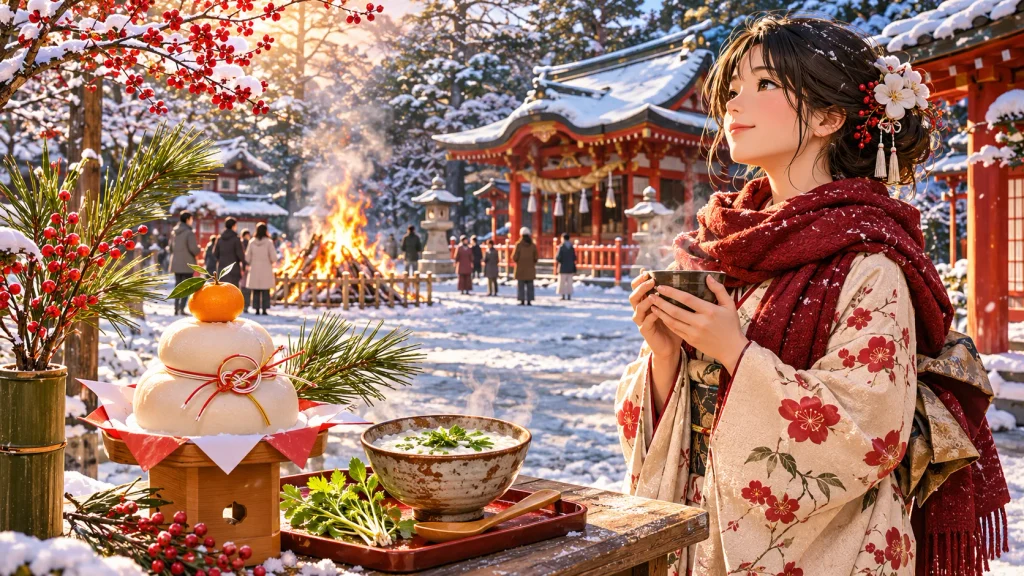
January 7 is nanakusa-gayu, a rice porridge made with seven spring herbs, and the day decorations come down around Tokyo. January 11 is kagami biraki, when the offering rice cake, hardened after ten days on the shelf, is broken with a mallet and eaten, often in sweet red bean soup called oshiruko. Around January 15 comes dondo-yaki (どんど焼き), when shrines and neighborhoods light bonfires and burn the decorations, old charms and kakizome sheets together. The smoke is said to send the toshigami back.
For the US version, take your decorations down on January 7 or 15, whichever fits your week. Keep your word paper until the 15th, then retire it: recycle it, or tuck it into your planner as a record of what you chose. Skip burning anything at home unless it is safe and allowed where you live, since many towns restrict open fires.
Once the season is closed, you may want another Japanese ritual to carry into winter. The Japanese onsen ritual is one place to start, and the full Japanese Wellness & Lifestyle section has more.
Questions People Ask About Japanese New Year
Japanese New Year (Oshōgatsu) falls on January 1, the same date as in the US. Japan has used the Gregorian calendar since 1873. The core holiday is January 1 to 3, and the season runs from mid-December preparations to bonfires around January 15.
No. Japan moved its New Year to January 1 in 1873, while Chinese New Year follows the lunar calendar and lands in late January or February. Some Chinese communities in Japan still celebrate it, but it is a separate holiday with different customs.
The main holiday is January 1 to 3. Preparations start around December 13, decorations stay up until January 7 around Tokyo or January 15 in the Kyoto and Osaka area, and the season closes with bonfires near January 15.
After the year turns, the greeting is “akemashite omedetō gozaimasu,” roughly “congratulations on the new year opening.” Friends shorten it. It is not said before January 1, and many people follow it with “kotoshi mo yoroshiku onegai shimasu,” which means “please look after me again this year.”
No. The home customs, such as cleaning, thank-you notes and a New Year’s Eve soba, are cultural rather than religious. Shrine and temple visits take place in religious settings, so go respectfully, follow posted rules, and learn what each custom means before you borrow it.
Sources
- National Diet Library, Japan: “Calendar History 2.” The November 1872 announcement and the switch to the Gregorian calendar in 1873. https://www.ndl.go.jp/koyomi/e/history/calendar.html
- Ministry of Justice, Japan: Japanese Law Translation, “Act on National Holidays.” New Year’s Day, January 1, as a national holiday. https://www.japaneselawtranslation.go.jp/en/laws/view/4846
- Tokyo Fire Department: guidance on choking accidents from mochi (Japanese-language page). https://www.tfd.metro.tokyo.lg.jp/lfe/nichijo/mochi.html
Dates and customs not linked above are widely documented and vary by household and region.