

Winter Indoor Workout for Beginners: A No-Equipment Routine for Cold Rooms and Small Spaces
A winter indoor workout for beginners can be five moves, one kitchen chair, one wall, and about 20 minutes. No equipment, no jumping, no gym. This guide gives you that routine in full, plus a 10-minute version, a 30-minute version, and a 5-minute version for the days when nothing goes to plan.
It’s built for the problems that show up when it’s cold: a bedroom that sits at 62 degrees in the morning, a tile kitchen floor, a neighbor right below you, and a sky that’s dark by 5:30. If you’ve never done a strength workout, you can start today. If you’ve tried before and quit, the shorter versions and the easier option for every move are there so you don’t have to.
Each section below works on its own. Jump to whatever you need first.
Also Read :- https://kheltechie.in/what-to-wear-walking-in-cold-weather-for-women/
The Beginner Winter Workout at a Glance
The routine has five moves. You do them in order, march in place for 30 seconds between moves, rest for a minute, and go around once more. With a 5-minute warm-up and a 3-minute cooldown, the whole thing takes about 20 minutes. Do it three days a week with a rest day in between.
| Move | Reps or time | Easier version | Quiet note |
|---|---|---|---|
| 1. Chair squat | 10 reps | Hands on your thighs, tap the chair | Lower slowly, don’t drop onto the seat |
| 2. Wall push-up | 8 reps | Stand closer to the wall | Silent on any floor |
| 3. Supported reverse lunge | 6 per side | Shorter step, hold the counter | Set the foot down softly, toe first |
| 4. Glute bridge | 12 reps | Lift a little less high | Lower slowly, rug or towel underneath |
| 5. Counter plank | 20 seconds | Hands on the wall instead | Silent on any floor |
Between each move, march in place for 30 seconds. After the fifth move, rest for 60 seconds, then do the whole round once more.
This guide calls it the Cold-Start 5, because it’s built to get a cold body moving without a single jump. The march between moves is on purpose. It keeps you warm while you rest, which matters more in a 62-degree room than it does in a gym.
Times are approximate. Your pace, your lunge step, and how long you take to set up all move the clock a little.

What You Need and What You Can Skip
You need a sturdy chair, a wall, a kitchen counter or sturdy table, and a patch of floor about 6 feet by 4 feet. That’s the full list.
↬ The chair: Use a dining chair or any solid chair with four legs. Skip office chairs and anything on wheels. Push the chair’s back against a wall before you start, so it can’t slide out behind you when you squat.
↬ The counter: This is for the plank and for balance during lunges. A kitchen counter works, and so does a heavy table. It has to be fixed in place. A rolling cart or a bar stool will move when you lean on it.
↬ The floor: Hardwood and laminate are slippery in socks, and lunges are where you’ll feel it. Wear sneakers indoors, go barefoot, or use grip socks. On cold tile, put a rug or a folded bath towel under your feet and under your back for the glute bridge. Carpet is fine as it is.
↬ Heat: If you use a space heater, keep it a few feet away from where you’re moving. Don’t work out right next to it.
You don’t need a mat, bands, or dumbbells. If you already own them, leave them in the closet for now. This routine doesn’t use them.

How to Warm Up in a Cold Room (5 Minutes)
Keep your hoodie on and give yourself five minutes before the first squat. In a cold room, the first few minutes tend to feel stiff, mostly in the hips and shoulders. The warm-up is there to loosen that up.
- March in place with arm swings, 90 seconds: Start slow and add speed as you warm up.
- Arm circles, 30 seconds: Small circles forward for 15 seconds, then back for 15.
- Hip circles, 30 seconds each direction: Hands on your hips, draw big, slow circles.
- Shoulder rolls, 30 seconds: Roll them up, back, and down.
- Side steps with arm swings, 30 seconds: Step side to side. No hopping.
- Easy chair squats, 8 slow reps: Hands on your thighs, light taps on the chair.
You’re ready when you feel a little warm, your breathing is quicker than when you started, and your hips and shoulders move more freely than they did five minutes ago. Take off a layer when you start to sweat, not before.
Skip long stretches at this point. Moving works better than holding a stretch when you’re cold. Save the stretching for the cooldown.
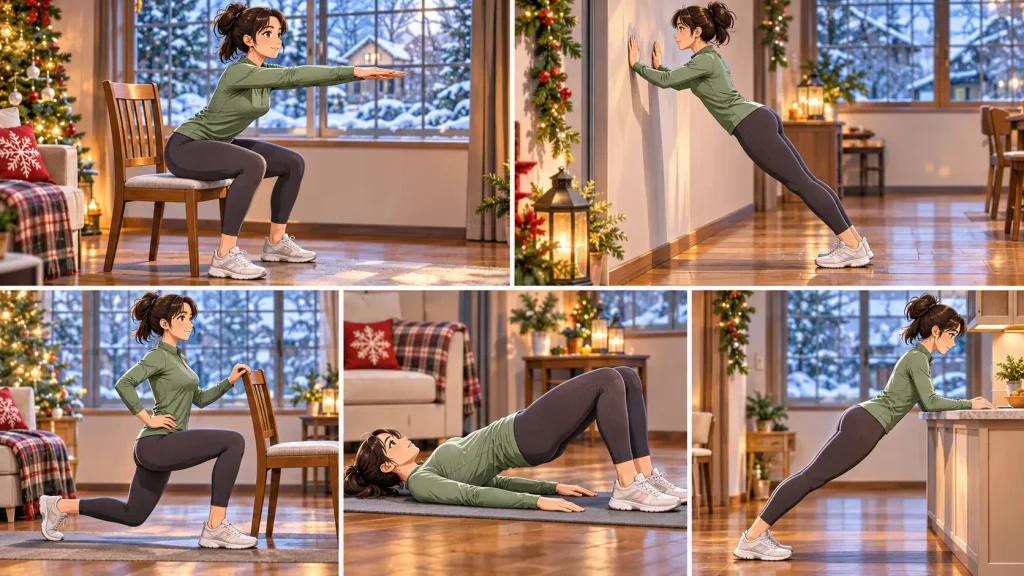
The 5 Moves: How to Do Each One (With Easier and Quiet Versions)
Each move below has the same layout: how to do it, the mistake to watch for, an easier version, a harder version, and how to keep it quiet.
⇝ Chair Squat
The chair squat builds the front and back of your thighs and your glutes. The chair gives you a target to aim for and keeps the depth consistent.
- Push a sturdy chair against a wall. Stand about one foot in front of it, feet about shoulder-width apart.
- Cross your arms over your chest or hold them out in front of you.
- Push your hips back and bend your knees, lowering until you lightly touch the seat. Don’t sit down.
- Press through your whole foot to stand back up.
Watch for: knees drifting inward as you stand. Think about pushing your knees out slightly, in line with your toes.
Easier: put your hands on your thighs, or sit fully and stand up. Harder: take three seconds to lower, or pause for two seconds just above the seat.
Quiet: lower under control. The thump onto the seat is the noisy part.
⇝ Wall Push-Up
The wall push-up works your chest, shoulders, and the backs of your arms with far less load than a floor push-up. It’s where most people should start.
- Stand about an arm’s length plus a few inches from a wall.
- Place your hands on the wall at shoulder height, a little wider than your shoulders.
- Keep your body in a straight line from head to heels. Bend your elbows and bring your chest toward the wall, elbows at roughly 45 degrees from your sides.
- Push back to the start.
Watch for: your hips sticking out behind you or your head leading the movement. Squeeze your glutes lightly and keep your neck in line with your spine.
Easier: stand closer to the wall. Harder: walk your feet back one step, or move your hands to the counter.
Quiet: this one makes no noise.
⇝ Supported Reverse Lunge
A reverse lunge, where you step backward, is usually easier to control than a forward lunge. Holding a counter takes balance out of the equation so you can focus on the movement.
- Stand next to a counter or behind a chair back. Rest one hand lightly on it.
- Step one foot back about one stride, landing on the ball of the foot with the heel up.
- Bend both knees and lower your back knee toward the floor. Stop a couple of inches above it.
- Press through your front foot to stand. Do all 6 reps on one leg, then switch.
Watch for: leaning your chest forward or taking a step that’s too short. Keep your torso tall and your front shin close to vertical.
Easier: take a smaller step and lower less. If a knee complains, stop going deeper and stay in the range that feels fine. Harder: let go of the counter, then slow the lowering to three seconds.
Quiet: place the back foot down gently. Stomping is what the neighbors hear.
⇝ Glute Bridge
The glute bridge works your glutes and the backs of your thighs, and it’s easy on the knees. It’s also the one move in this routine that happens on the floor, so a rug or towel helps on a cold surface.
- Lie on your back with your knees bent and your feet flat, hip-width apart, about a foot from your hips.
- Press through your heels and lift your hips until your body makes a straight line from shoulders to knees.
- Squeeze your glutes for one second at the top.
- Lower slowly. Your hips can touch the floor lightly before the next rep.
Watch for: arching your lower back to get higher. Keep your ribs down and lift only as high as your glutes can drive you.
Easier: a smaller lift. Harder: hold the top for two seconds, then try one leg at a time.
Quiet: lower slowly onto a rug or towel.
⇝ Counter Plank
The counter plank trains your abdominals and shoulders. Raising your hands to a counter takes load off compared with a floor plank, so you can hold good form.
- Place your hands on the edge of a fixed counter, shoulder-width apart.
- Walk your feet back until your body forms one straight line from head to heels.
- Squeeze your abs and glutes. Look at the counter just in front of your hands.
- Hold for 20 seconds and keep breathing.
Watch for: hips sagging or rising into a peak. If your hips move, the hold is over for that set.
Easier: put your hands on the wall. Harder: hold for 30 to 40 seconds, then move to a floor plank on your knees.
Quiet: this one makes no noise.

The Full Routine, Step by Step
Do legs first, then upper body, then core. The big leg muscles heat you up fastest, so the routine starts there. Here’s the order:
- Warm-up, 5 minutes: See the warm-up above.
- Round 1: 10 chair squats, march 30 seconds. 8 wall push-ups, march 30 seconds. 6 reverse lunges per side, march 30 seconds. 12 glute bridges, march 30 seconds. 20-second counter plank.
- Rest 60 seconds: Walk around the room and shake out your arms.
- Round 2: Repeat round 1.
- Cooldown, 3 minutes: Walk slowly in place for 1 minute. Hold a standing quad stretch for 30 seconds per side, with a hand on the counter. Then hold a chest stretch for 30 seconds per side, with one hand flat on the wall and your body turned gently away.
Move at a steady pace. A simple guide: about two seconds to lower, one to two seconds to come up. Breathe out on the effort, like when you stand from the squat or push away from the wall. If you’re holding your breath, you’re going too hard.
Each round takes about four and a half minutes, so two rounds, the rest, the warm-up, and the cooldown come to roughly 20 minutes.

10, 20, or 30 Minutes: Pick the Version That Fits Your Day
You don’t need a free hour to do this. Use the same five moves and change how many rounds you do.
| Version | Warm-up | Main work | Cooldown | Total |
|---|---|---|---|---|
| 5-minute minimum | 2 minutes of marching and arm circles | 1 set each of chair squat, wall push-up, and glute bridge | None | About 5 minutes |
| 10-minute | 3 minutes | 1 full round | 1 to 2 minutes | About 10 minutes |
| 20-minute (standard) | 5 minutes | 2 full rounds | 3 minutes | About 20 minutes |
| 30-minute | 5 minutes | 3 full rounds, 90 seconds rest between rounds, then a 4-minute march and side-step finisher | 3 minutes | About 30 minutes |
Here’s how that plays out. Say you work from home and have 12 minutes before a 1 p.m. call. That’s the 10-minute version. Say it’s Saturday morning and you have nothing planned. That’s a good day for 30. Say you’re sick of everything and the idea of exercise makes you want to lie on the floor. That’s the 5-minute version, and doing it still counts as a workout day.
On any day, do the 5-minute version instead of nothing. Showing up matters more than the length, especially in the first few weeks.

How Many Days a Week Should a Beginner Do This?
Three days a week, with a rest day between each. For example: Monday, Wednesday, Friday. The other days are for rest or for ordinary movement around the house.
The CDC’s adult guidelines say adults need at least two days a week of muscle-strengthening activity that works all the major muscle groups, on top of 150 minutes a week of moderate aerobic activity. This routine covers the muscle-strengthening part: legs, hips, chest, shoulders, arms, and abdomen. It doesn’t train your upper back directly (there’s a fix for that in the level-up section below), and it isn’t aerobic exercise, so it’s one piece of the CDC’s weekly picture, not all of it.
Two days is the minimum. Three days gives you room to miss one and still hit two.
Picking a time: In December, much of the US is dark by about 5:30 p.m. If your plan is “after work,” you’ll be tired, cold, and in the dark. A fixed slot earlier in the day is easier to keep. Right after you wake up, before your first meeting, at lunch, or while the kids nap all work, and so does any 10-minute gap you can count on. Leave the chair against the wall and the towel where you’ll need it, so setup takes ten seconds.
Tracking: For the first two weeks, count sessions, not reps. A check mark on a calendar is enough.
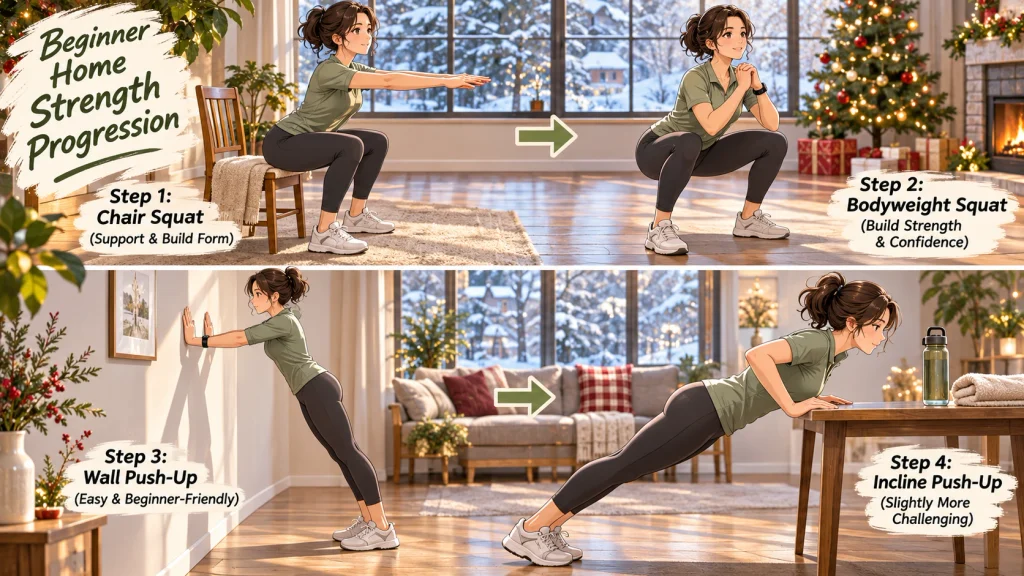
Easier or Harder? Find Your Starting Level and Know When to Move Up
Run these three checks before your first workout. They take about a minute and tell you which version of each move to start with. This isn’t a fitness test. It just picks a starting point.
- Chair stand check. Stand up from a chair five times without pushing off with your hands. If that feels smooth, start with the standard chair squat. If you need your hands or it feels wobbly, start with hands on your thighs.
- Wall push-up check. Do eight wall push-ups with a straight body line. If they feel easy, step your feet back one step at your next session. If you can’t finish eight, stand closer.
- Plank check. Hold a counter plank for 20 seconds with your hips level. If your hips sag early, hold it for 10 to 15 seconds or move your hands to the wall.
Each move has a ladder. Start on the step that feels challenging but clean, and climb when you’re ready.
| Move | Step 1 | Step 2 | Step 3 | Step 4 |
|---|---|---|---|---|
| Squat | Hands on thighs, tap the chair | Chair squat, arms crossed | Chair squat, 3-second lower | Squat with a 2-second pause, no chair |
| Push-up | Wall, standing close | Wall, feet farther back | Counter or sturdy table | Floor, on your knees |
| Lunge | Supported, short step | Supported, deeper | No support | No support, 3-second lower |
| Bridge | Small lift | Full lift | 2-second hold at the top | Single-leg bridge |
| Plank | Wall plank | Counter plank, 20 seconds | Counter plank, 30 to 40 seconds | Floor plank on your knees |
When to move up: When you finish every rep with steady form in two sessions in a row, move one move up one step. Change one thing at a time, and wait about two weeks before changing the next. If you change everything at once in week one, you won’t know what’s working.
The upper back gap: The five moves don’t directly train your upper back. After three or four weeks, add one more move: lie face down with your forehead on the floor and your arms by your sides, lift your chest an inch or two, hold for two seconds, and lower. Do six reps. Skip it if it bothers your lower back.
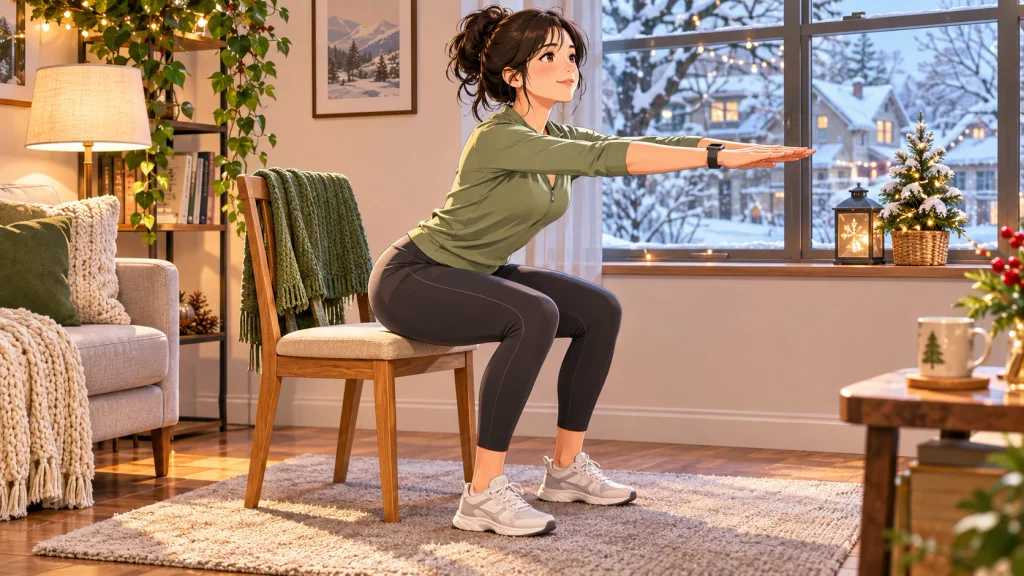
Making the Workout Quiet for Apartments and Shared Walls
The Cold-Start 5 has no jumping, so it’s already quiet. What makes noise in an apartment is landing, dropping, and stomping. If you also follow video workouts, use these swaps:
| Noisy move | Quiet swap |
|---|---|
| Jumping jacks | Step jacks: step one foot out and raise both arms, then switch |
| High knees | Slow marching with big arm swings |
| Squat jumps | Chair squats or slow bodyweight squats |
| Burpees | Skip them. A wall push-up plus a squat covers the same muscles |
| Mountain climbers | Counter plank |
Hard floors carry thumps through to the room below, so a rug or thick towel under your feet helps. Move slowly, place your feet down on purpose, and lower yourself into every rep instead of dropping.

Staying Warm Before, During, and After
Before: Keep your warm layers on through the warm-up. Take one off when you notice you’re sweating.
During: The 30-second marches between moves keep your body temperature up while you rest. If you stand still between exercises in a cold room, you’ll cool down fast and start the next move stiff.
After: The chill often comes when you finish, not while you work. You’ve warmed up and maybe sweated a bit, then you sit in a cold room in a damp shirt. Walk around for a minute, change out of anything damp, and put on dry socks.
Common Beginner Mistakes in Winter Workouts
- Skipping the warm-up because it’s cold and you want it over. The cold is the reason to do it. Give it the full five minutes.
- Racing the reps. Fast, sloppy reps feel like harder work but do less. Slow down and count.
- Holding your breath. It happens most in the plank and push-up. Breathe out on the effort. Counting out loud helps.
- Letting the hips sag in the plank. End the set when your hips move. A good 15 seconds beats a bad 30.
- Changing too much too fast. Adding rounds and cutting rest in week one is a quick way to feel wrecked and quit. Change one thing every two weeks.

When to Stop or Check With a Doctor
Stop and rest if you feel sharp joint pain, dizziness, or you can’t catch your breath. If you feel chest pain or severe shortness of breath, stop and get medical help. Mild muscle soreness a day or two after your first sessions is common and fades. Sharp pain, or pain that lingers, is different.
Talk to a doctor before you start if you have a heart, lung, or joint condition, a recent injury, or you’re pregnant or postpartum. The same goes if you’ve been inactive for a long time and aren’t sure where to begin. This article is general information and not medical advice.
Also Read :- https://kheltechie.in/best-walking-pads-for-small-spaces/
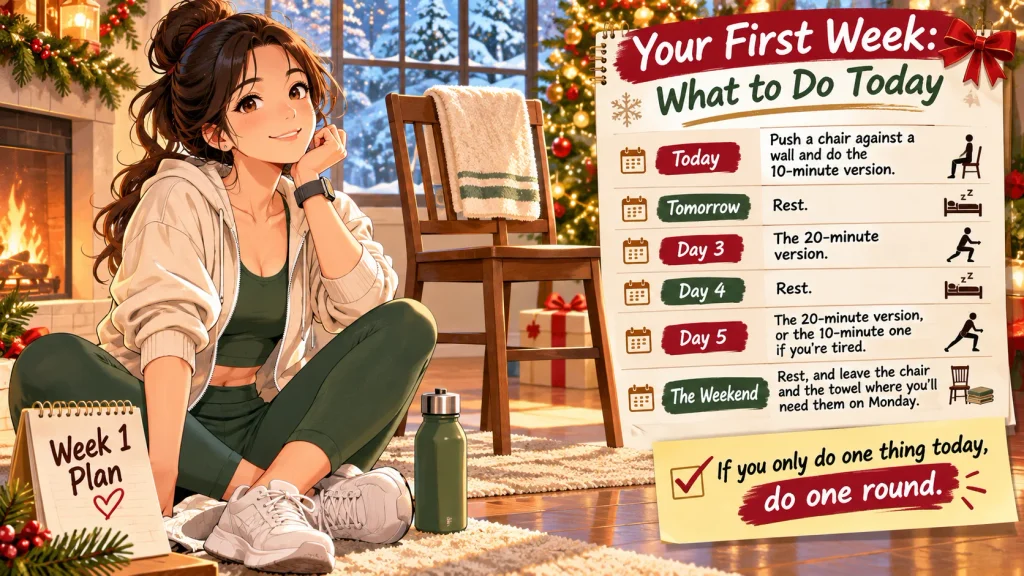
Your First Week: What to Do Today
- Today: push a chair against a wall and do the 10-minute version.
- Tomorrow: rest.
- Day 3: the 20-minute version.
- Day 4: rest.
- Day 5: the 20-minute version, or the 10-minute one if you’re tired.
- The weekend: rest, and leave the chair and the towel where you’ll need them on Monday.
If you only do one thing today, do one round.
Questions Beginners Ask
Yes. For a beginner, your own body weight is enough resistance to be challenging. As the moves get easier, you make them harder by slowing them down, pausing, or moving up the ladder in this guide. No equipment needed.
Start with 10 to 20 minutes. The 20-minute version in this guide includes the warm-up and cooldown. On a busy or low-energy day, 5 minutes still counts and keeps the habit going.
Three days a week with a rest day between works well for beginners. The CDC’s adult guideline asks for muscle-strengthening on at least two days a week, so three gives you room to miss one.
For most healthy adults, a cool room is fine if you warm up and dress in layers. If cold air bothers your breathing, or you have a heart or lung condition, check with your doctor first.
That’s normal, and it’s why the routine starts at the wall. Stand close to the wall, do your reps, and move down one step at a time: wall, counter, knees, then the floor.
Yes. The routine has no jumping. Lower slowly, set your feet down softly, and use a rug or towel under your feet and back. See the quiet swaps above if you follow video workouts.
Source
- Centers for Disease Control and Prevention. “Adult Activity: An Overview.” https://www.cdc.gov/physical-activity-basics/guidelines/adults.html