

Kaizen New Year’s Resolutions: Small Steps That Last Past January
Pick one Resolution, Write the smallest version of it you would still do on a bad day. Attach that version to something you already do every day, and check its size once a month. That is a kaizen New Year’s resolution. It asks for less than you think you can do, on purpose, so it survives the weeks when you can do very little.
The step most guides skip is the first one: turning a resolution into something you can actually do. “Learn Japanese” can’t be done at 7:40 on a Tuesday morning. One hiragana character can (hiragana is one of the two syllable scripts Japanese uses). “Keep in touch with people” can’t be done either, but one message to one person can. Below you’ll find a four-question worksheet for making that translation, then a month-by-month plan for the twelve months that follow, including the months with travel, new school schedules, and holidays.
If you want the method itself, meaning the four steps and a seven-day start, our guide to the kaizen method for daily habits covers it. This guide starts where that one stops: with your resolution, and with the year after January 1.

How a Kaizen Resolution Differs From a Regular One
A regular resolution and a kaizen resolution can aim at the same thing. The difference is in how each one is written and how long it is expected to run.
A regular resolution is a goal with a finish line: read twelve books, learn Japanese, finish the portfolio. It is usually written as a result, and it gets judged once, on December 31. Kaizen has no finish line. The word is usually translated as continuous improvement, so the step is meant to keep going and keep changing. Your resolution picks the direction. Kaizen sets the size of each step and the pace.
| Regular resolution | Kaizen resolution | |
|---|---|---|
| Written as | A result (“be more present”) | An action (“ask one real question at dinner”) |
| Size | As big as your motivation on January 1 | Small enough for your worst day |
| Checked | Once, in December | Once a month |
| When it slips | Restart big, or drop it | Restart smaller |
One correction before going further: Kaizen is sometimes described as an ancient Japanese philosophy. It is a method that grew out of Japanese manufacturing after World War II1, and the personal version used for habits and resolutions is more recent still. The full history is in the kaizen method guide, so we won’t retell it here.
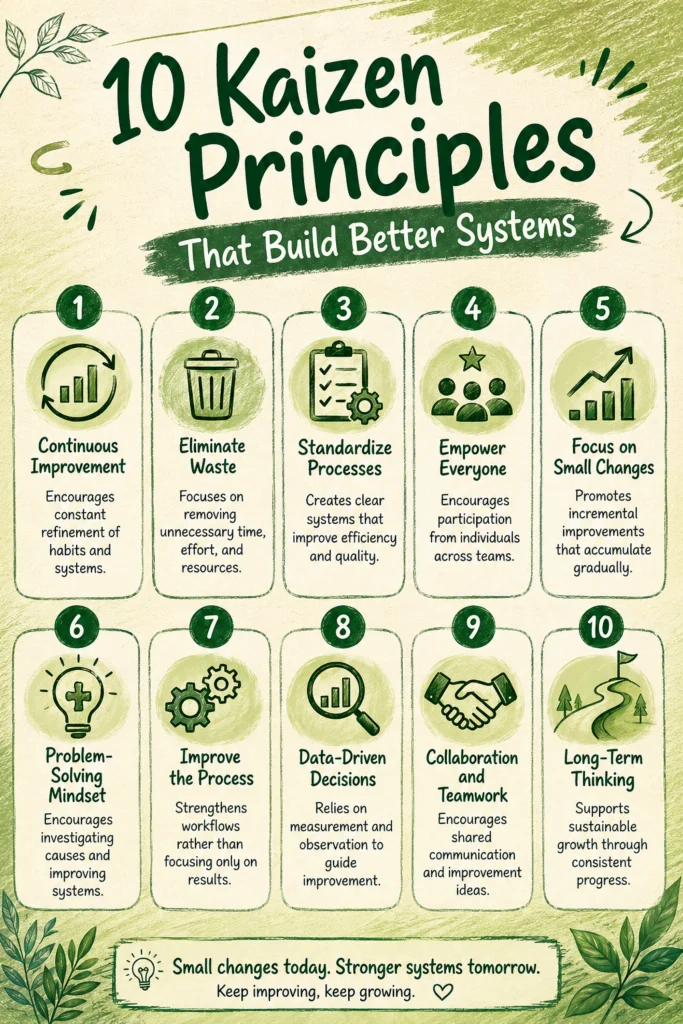
10 Kaizen Principles, Translated for a Resolution
Lists of kaizen principles were written for factories and teams, so they read oddly when you are one person with one resolution. Here are ten commonly listed principles, reworded for personal use. Each row also points to the section of this guide where the idea gets used.
| Principle | For a resolution | Where it shows up (in section) |
|---|---|---|
| 1. Continuous improvement | There is no finish line. The step stays, and it grows slowly | How it differs, 12-month rhythm |
| 2. Eliminate waste | One in, one out: drop one small thing to make room for the step | One in, one out |
| 3. Standardize processes | Same moment every day, so you never have to decide when | Resolution Rewrite |
| 4. Empower everyone | Tell one person your step, and let others pick their own. Don’t recruit the whole house | Resolution Rewrite |
| 5. Focus on small changes | The first step fits on your worst day | Resolution Rewrite |
| 6. Problem-solving mindset | When a step slips, fix the moment or the size before you blame yourself | When life interrupts |
| 7. Improve the process | Make the step easier before you make it bigger | 12-month rhythm |
| 8. Data-driven decisions | Count one thing, like days done this month, and decide from the count, not your mood | 12-month rhythm |
| 9. Collaboration and teamwork | In a shared home, share a moment: you both do your own step after dinner | Resolution Rewrite |
| 10. Long-term thinking | Pick a size you could keep for years, not one that looks impressive in January | How it differs, 12-month rhythm |
This reading is ours, a way to apply the ideas to personal life, not a research finding. The plan-try-check-adjust cycle behind most of these, and the “five whys” habit for fixing a stalled step, are both explained in the kaizen method guide.

Turn Your Resolution into a First Step: the Resolution Rewrite
The Resolution Rewrite is a four-question worksheet that turns a resolution into one action you can do today. Take your resolution and answer these in order, in writing.
- What should be different by December? Describe what someone watching your life would notice. “I can read hiragana without a chart” is noticeable. “I’m better at Japanese” is not.
- What is the smallest visible action toward that? Visible means you could show it to someone: a character written on a card, a message sent, a sentence added to a file.
- What is the bad-day version? Decide in advance the even smaller version you will do when you are sick, late, or worn out. Reading the card once counts.
- Which moment already in your day carries it? Choose something that happens daily without effort: dinner cooking, your laptop closing after the last call, sitting down to eat.
Here are four resolutions put through the worksheet. They are illustrations, not case studies, and your answers will differ.
| Resolution | Different by December | First step | Bad-day version | Moment |
|---|---|---|---|---|
| Learn Japanese basics | You can read the 46 basic hiragana without a chart | Write one new character on an index card | Read yesterday’s card once | While dinner cooks |
| Keep in touch with people | No one on your short list has gone two months without hearing from you | Send one line to one person: a photo, a link, a “thinking of you” | React to a message someone sent you | After Sunday lunch |
| Finish a personal project (a course, a portfolio, a plan) | It is done, and one person has seen it | Write or fix one sentence | Open the file and reread the last paragraph | Right after your first call or class of the day |
| Be more present at home | The people you live with would say you listen more at dinner | Ask one question that isn’t about logistics | Listen to the whole answer to “How was your day?” | When you sit down to eat |
Take the first row: Hiragana has 46 basic characters, so one new character a day covers the whole set in about six and a half weeks. That number tells you something useful: this first step has a natural ending. When the cards run out, the step doesn’t stop. It changes, for example to reading short words built from the characters you already know. You couldn’t have planned that on January 1 from the phrase “learn Japanese,” and you didn’t need to.
Keep your answers as a four-line card on the fridge or in your notes app:
Direction: Learn Japanese basics.
First step: Write one new hiragana character on a card.
Bad-day version: Read yesterday’s card once.
Moment: While dinner cooks.
The bad-day version matters more than it looks: Most plans are written for the person who has time, and most missed weeks are lived by the person who doesn’t. Writing the smaller version while you’re calm gives that second person something to do. On a bad day, doing the small version counts as doing it. The monthly check, covered below, decides whether the usual size needs to change.

Choose One Resolution, and Give the Others a Month
Every resolution needs its own two minutes and its own moment in the day, and most days have only a few free moments like that. This is why a kaizen year runs one resolution at a time.
Your other ideas don’t get thrown away. Keep a parking lot: a short list of the other resolutions you care about, each with a start month. A parking lot for the example above might look like this:
- Learn Japanese basics: starts in January.
- Keep in touch with people: parked until May.
- Finish the portfolio: parked until September.
The start months line up with the 12-month rhythm below, where May is the first month a second resolution is allowed to begin. A parked resolution still gets its Resolution Rewrite now, while you’re clear-headed. You just don’t start it until its month.
If you can’t decide which one goes first, ask which resolution you would still want if nobody ever knew you did it. Picking for an audience is an easy way to pick the wrong one. If that doesn’t settle it, the exercise in our guide to finding your ikigai step by step is a longer way to work out what you want more of.

The 12-month Rhythm: Start, Hold, Add, Rest
The 12-month rhythm is a plan that gives your kaizen resolution one decision per month, so you know what the step should be doing in March, in July, and in November. It is our own rule of thumb, built from the principles above, and not a research result. Treat the month assignments as a starting point and adjust them to your life.
| Month | Decision | What it looks like |
|---|---|---|
| January | Start | Pick the size from your Resolution Rewrite and keep it for four full weeks. No changes. |
| February | Hold | Keep it boring. The job this month is proving the step survives ordinary weeks. |
| March | Size check | If the step felt easy all month, add one rung. If not, hold. |
| April | Hold | Stay at the new size for the whole month. |
| May | Add | The first month a second resolution may start, at its smallest size, and only if the first one runs without effort. |
| June | Midyear check | Keep, shrink, add, or rest. Write one sentence on what has changed since January. |
| July | Summer lite | Travel, visitors, kids home from school. Run the bad-day version on purpose. |
| August | Summer lite | Same again. Planning a lighter month means it doesn’t count as a miss. |
| September | Reset | New school or work schedule. Pick a new moment for the step if the old one moved. |
| October | Hold or add | Back to normal size. Add one rung only if September’s reset held. |
| November | Holiday lite | Bad-day version by plan through the holiday weeks. |
| December | Rest and look back | Pause the step for a week if you like, write what changed, and choose next year’s first step. |
A rung is the smallest increase you would notice: one extra word, one extra minute, one more person on the list. Adding a rung is the only way the step grows, and it can only happen at a monthly check.
The monthly check takes five minutes and ends in one decision from this menu:
- Hold: nothing needs to change. This is the default.
- Add: the step was easy on almost every day this month. Add one rung.
- Shrink: you missed it more days than you did it. Cut the step in half.
- Rest: a planned pause, for a trip, a heavy month, or December.
- Start: a parked resolution begins, at its smallest size.
Count the days you did the step and let that number choose from the menu. The weekly Hansei review in the kaizen method guide is good for catching problems early. This monthly check does one thing only: it decides size.
Here is how the first example could run across a year, as an illustration:
- January and February: one new hiragana character a day on index cards. The set of 46 is finished in mid-February.
- March: size check. The step was easy, so add one rung: after writing the new character, read one short word built from characters you already know.
- April: hold.
- May: the parked resolution starts at its smallest size, one line to one person after Sunday lunch.
- July and August: during a two-week trip, the card step drops to the bad-day version.
- September: dinner moves to a later time because of a new activity schedule, so the step moves to when dinner starts.
- November: holiday lite.
- December: look back, write down three words you can now read that you couldn’t in January, and pick next year’s first step.

When Life Interrupts: Restarting After a Week or a Month Away
A single missed day is handled in the missed-day table of the kaizen method guide. This section is for longer gaps: a sick week, a trip, houseguests, or a deadline that swallows a month.
The rule behind everything below is simple. You restart smaller than you stopped, and you never make up the missed days. Catch-up is what turns a gap into a pile.
| The gap | Restart at | Then |
|---|---|---|
| 2 to 6 days | The same size | Same moment. No catching up. |
| 1 to 3 weeks | Half size for one week | Return to your normal size. |
| A month or more | The bad-day version for two weeks | Do a size check and decide. |
| The moment itself is gone (new job, a move, a new schedule) | Pick the new moment first | Restart at half size. |
These sizes are our own rule of thumb. The four interruptions below are the ones that come up most often:
- Travel: Decide before you leave whether the step travels. An index card in your wallet does. A notebook on your desk doesn’t. If the step can’t travel, plan the bad-day version for the trip, then use the table above when you’re home.
- A sick week: Nothing to make up. When you feel like yourself again, restart at the size from the table. If your resolution is tied to a health condition, follow your clinician’s advice over anything in this guide.
- Houseguests or family visits: Your usual moment is probably taken. Pick a temporary one nobody shares, such as the first ten minutes of the morning, and keep the step there for the length of the visit.
- A work or school crunch: Name the bad-day version out loud on the first day of the crunch. A step you shrink on purpose stays alive. A step you drop silently tends to stay dropped.
Write down the restart date, not an apology. “Restart Monday at half size” is a plan. If a long gap leaves you feeling like you failed, our guide to kintsugi philosophy is a gentler read on repair than anything here.

One In, One Out: What to Stop Doing
Every new step needs a slot in your day, and kaizen’s answer to that is to remove something small at the same time you add the step.
Look at the moment you chose in the Resolution Rewrite. Something already happens there: scrolling while dinner cooks, checking email while the laptop wakes up. The new step doesn’t add to your day. It replaces the weakest thing that was already happening at that moment, which is why a two-minute step can fit even in a full schedule.
There is a second kind of stopping that gets overlooked. Retire last year’s resolution on purpose. If an old one still sits in the back of your mind as unfinished, write “done,” “parked,” or “dropped” next to it, with a date. It stops hanging around as an open item, and you can decide whether the parked ones belong in this year’s parking lot.
When you are not sure what to drop, use one test: would I sign up for this again today? If the answer is no, it is a candidate. Drop one thing at a time, and drop it when you add the step, not later.

When Kaizen is the Wrong Tool
Kaizen works by shrinking things, and some things can’t be shrunk. These are the cases where another approach fits better.
- Fixed deadlines: A tax filing, a school application, a lease ending. Small steps can help you prepare, but the date doesn’t get smaller. Put the date on your calendar first and work backward.
- All-or-nothing decisions: Taking a job offer, signing a lease, moving. You can use small steps for the preparation, but the decision itself is one decision.
- Anything touching a health condition or medication: That plan belongs to you and your clinician. This guide is general lifestyle information and is not medical advice.
- A step that has outgrown its size: If you have held the same size for three months, it has been easy, and nothing around it has changed, a bigger step may be right. Kaizen is a pace, not a promise to stay small.
Failure Statistics and Brain Explanations: What to Make of Them
Search for this topic and you will meet two kinds of claims, and this section explains why you won’t find either one used as a fact in this guide.
The first is a failure rate for New Year’s resolutions: The figures run from about 80% to over 90%, and a few pages quote a small share of people who kept all of theirs. Most don’t say who was surveyed or when. A number we can’t trace isn’t something to build your year on, so we don’t use any of them.
The second is a brain explanation: small steps work because they slip past a fear response. It is a tidy picture and it may help you remember the method, but this guide doesn’t rely on it. The method stands or falls on something you can check yourself. How many days this month did you do the step? That count is the only number we ask you to trust, and it is the one the monthly check uses.

Your First 10 Minutes
You can set up your whole year in about ten minutes, and you don’t have to wait for January 1 to do it.
- Pick one resolution (2 minutes): If two are fighting for first place, use the “nobody would know” test from above.
- Write your four-line card (5 minutes): Direction, first step, bad-day version, moment.
- Give each parked resolution a start month (2 minutes): May and September are good defaults.
- Put your first monthly check in your calendar (1 minute): Choose the first weekend of the month after you start.
Then do the step once tonight, at its bad-day size. That is enough for day one.
Questions About Kaizen Resolutions
Nothing can promise that. Kaizen has no finish line, so a step is allowed to run for years, but only if it stays sized for your real weeks. That is why this guide builds in a bad-day version, lighter months, and restart sizes: they protect the step when life gets heavy.
A SMART goal describes the target: specific, measurable, with a date. A kaizen step sizes the action you take toward it. The two fit together. Write the December outcome first, which is question one of the Resolution Rewrite, then shrink the action until you can do it on your worst day.
No. January 1 is a convenient date, not a requirement. The 12-month rhythm counts from the day you start, so shift the months to match. If you begin in October, your “January” decisions happen in October, and your holiday-lite weeks arrive early.
If you have held the same size for three months, it has been easy, and nothing around it has changed, the step is probably too small. Add one rung at the next monthly check. Before that point, a step that feels almost silly is doing its job. This is a rule of thumb, not a measured threshold.
Use kaizen for the preparation, not the decision. Small steps work well for things like updating a resume a little at a time or sorting what moves with you. Fixed dates, such as a lease ending or an offer deadline, stay where they are and go on your calendar first.
Run it through the Resolution Rewrite again and start at half the size you used last time. Then close the old attempt on purpose by writing “dropped” or “parked” and a date next to it, as described in one in, one out. A fresh, smaller version is easier to restart than the old, bigger one.
Sources
- Britannica Kids, “Kaizen.” Describes kaizen as a Japanese term for continuous improvement in manufacturing, brought to Japan after World War II. https://kids.britannica.com/students/article/Kaizen/311935