

New Year Healthy Habits Checklist: 11 Habits, Pick Only 3
A good new year healthy habits checklist has three boxes to tick, not twenty. Pick the three that match the problem you have right now (flat by 3 p.m., unable to switch off at night, mornings that start in a scramble, a low mood once the days get short) and give each one a clear “done.” Below are 11 habits to choose from, each with a time cost and a done-line.
Most January lists hand you 15 or 20 habits and then say “start small.” They skip the hard part, which is deciding which small habit. This page starts from the problem instead and works backward to the habit.
Kheltechie is a lifestyle blog, not a medical practice. Nothing here diagnoses or treats anything, and where a habit touches your health, your doctor has the final say.

Which Problem Do You Have Right Now?
Read the left column and stop at the first row that sounds like your week. If two rows fit, take the one that bothers you more. The right column lists which habits from the checklist below to look at first.
| Your problem | What it looks like | Look at these first |
|---|---|---|
| Tired by mid-afternoon | Third coffee by 2 p.m., foggy after lunch | Daylight in the first hour, water before coffee, ten-minute walk, fixed wake time |
| Can’t switch off at night | Phone in bed, brain still at work at midnight | Phone out of the bed, two-minute breathing reset, three-line plan, caffeine cutoff |
| Mornings start in a scramble | Hunting for keys, running five minutes late most days | Fixed wake time, three-line plan, water before coffee |
| Everything feels like effort by evening | Small decisions pile up and you stop making them | Three-line plan, screen-free meal, fixed wake time |
| Flat or low in the dark months | Less drive, more wanting to stay in | Daylight in the first hour, ten-minute walk, one real conversation |
| Days pass without talking to anyone | Lots of messages, hardly any voices | One real conversation, screen-free meal, ten-minute walk with someone |
The ten-minute walk and the three-line plan each appear in three rows, so if you cannot decide, either one is a safe first pick. If the “flat or low” row sounds heavier than a slow January, read the January section further down before you pick.
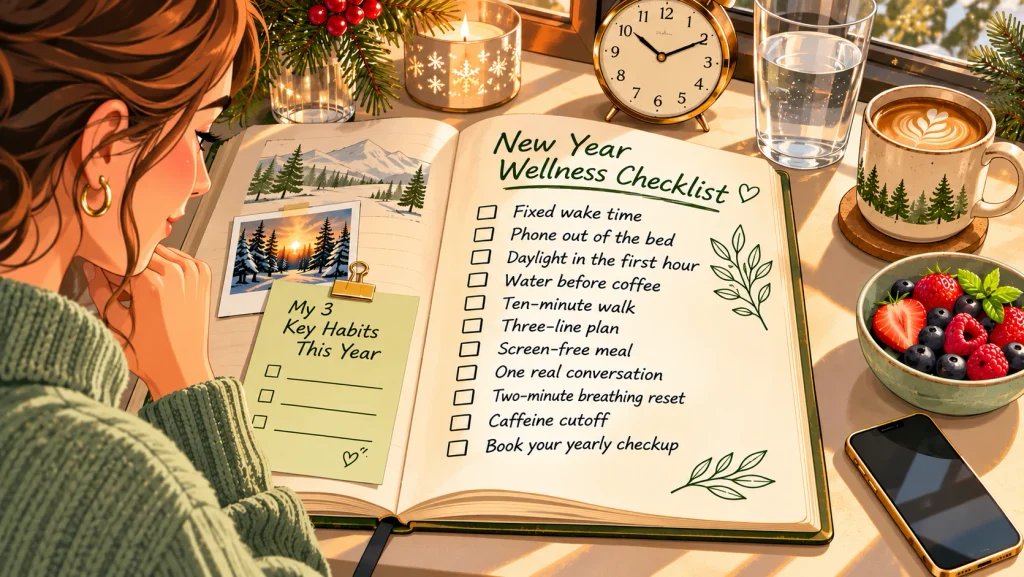
The 11-Habit Checklist
Every row has a time cost and a “done” line, so you know exactly when to tick the box. The minutes are our estimates for most people, and yours may differ. The done-lines allow for a few misses a week, because nobody ticks every box.
| Habit | Minutes | Done means | Helps with |
|---|---|---|---|
| ☐ 1. Fixed wake time | 0 | Up within an hour of your set time, 6 days out of 7 | Scrambled mornings, restless nights |
| ☐ 2. Phone out of the bed | 2 | Phone charging across the room, 6 nights out of 7 | Can’t switch off |
| ☐ 3. Daylight in the first hour | 10 | 10 minutes outside or at a bright window, 5 days out of 7 | Tired afternoons, flat mood |
| ☐ 4. Water before coffee | 1 | One glass finished before your first caffeine, 5 days out of 7 | Tired afternoons, scrambled mornings |
| ☐ 5. Ten-minute walk | 10 | Ten minutes on foot at any pace, 4 days out of 7 | Afternoon slump, low mood, feeling disconnected |
| ☐ 6. Three-line plan | 3 | Three lines written before bed, 5 nights out of 7 | Scrambled mornings, feeling overloaded |
| ☐ 7. Screen-free meal | 15 | One meal with your phone out of reach, 5 days out of 7 | Feeling overloaded, disconnected |
| ☐ 8. One real conversation | 5 to 10 | A call, voice note or in-person chat, 3 days out of 7 | Disconnected, flat mood |
| ☐ 9. Two-minute breathing reset | 2 | Timer finished once a day, 5 days out of 7 | Can’t switch off |
| ☐ 10. Caffeine cutoff | 0 | No caffeine after your cutoff time, 5 days out of 7 | Restless nights |
| ☐ 11. Book the yearly checkup | 10, once | Appointment on your calendar | Everyone |
1. Fixed wake time
Pick a wake time you can keep on a Sunday, not the one you wish you kept. The American Academy of Sleep Medicine and the Sleep Research Society recommend at least seven hours a night for adults 18 to 60, and the CDC’s own advice includes going to bed and getting up at the same times every day (both points come from a CDC news release).
Work backward: a 7:00 a.m. alarm means lights out around 11:30 p.m. The weekend sleep-in is where this habit usually breaks, so keep Saturday’s alarm within an hour of Monday’s.
2. Phone out of the bed
The same CDC release suggests taking TVs, computers and mobile devices out of the bedroom. The National Institute of General Medical Sciences adds that light from electronic devices at night can confuse the body’s clocks. Charge the phone somewhere you have to stand up to reach, like the kitchen counter or the hallway. If the phone is your alarm, a basic alarm clock solves that in one purchase.
3. Daylight in the first hour
The National Institute of General Medical Sciences says light and dark have the biggest influence on your body’s daily rhythms (NIGMS fact sheet). So step outside for ten minutes after you wake up, coffee in hand if you like. Outdoor light is usually far brighter than indoor light, even on a gray day. If you leave home before sunrise, take it at lunch and rename the habit “daylight before 2 p.m.” If it is too icy to go out, stand at the brightest window you have. That is a weaker version, but it beats a dim kitchen.
4. Water before coffee
Treat the glass as a cue that starts your morning. Fill it the night before, set it next to the coffee maker, and drink it while the coffee brews. It is not meant to hit a daily total. How much you need across the whole day depends on your size, your activity and your climate, so this checklist skips the number.
5. Ten-minute walk
This is a ten-minute break for your head, and pace does not matter. All of these count: around the block after lunch, up and down the driveway during a phone call, the first ten minutes after you get home. If you would rather follow a structured plan, our 30-day beginner fitness challenge has one.
6. Three-line plan
Before bed, write three lines on paper or in your notes app. Line one is the one thing that has to happen tomorrow. Line two is one thing just for you. Line three is one thing you are deliberately not dealing with tomorrow. A real one might read: “Send the invoice. Call Mom back. Not tomorrow: reorganizing the pantry.” Do not skip line three.
7. Screen-free meal
Choose the meal where you scroll the most and put the phone out of arm’s reach for that one. This one is about attention, and the meal is just the setting. If you eat with other people, you will probably notice the conversation first. If you eat alone, the quiet is the point, and you only need to hold it for the length of the meal.
8. One real conversation
A call, a voice note, or ten minutes in person. Texts and emoji reactions do not count here, because the habit is hearing a voice. An easy pairing: call someone while you do your ten-minute walk, and one slot does double duty.
9. Two-minute breathing reset
Set a timer for two minutes. Breathe in through your nose for a count of four and out slowly for a count of six, about a dozen rounds. Tie it to a moment you already have, like right before you open email or right after you park the car. Keep the exhale longer than the inhale. If you feel dizzy, stop and breathe normally.
10. Caffeine cutoff
Choose a time after which you have no coffee, caffeinated tea, energy drinks or cola. Early afternoon is a common pick, but the right time is whichever one lets you fall asleep without lying there. Run it for a week, and if nights are still restless, move it an hour earlier. A gradual cutoff beats a quit-coffee plan you drop on day three.
11. Book your yearly checkup
This is the only habit on the list that involves a professional, and the only one that needs a phone call. Call in the first week of January. Waiting until spring is how this item gets skipped.
Before you book, check your insurance. HealthCare.gov says all Marketplace plans and many other plans must cover a list of preventive services, such as screenings and immunizations, without a copayment or coinsurance when you use an in-network provider, and it adds that $0 is not guaranteed in every case (HealthCare.gov, preventive care for adults). Call the number on your insurance card or check the member portal, and ask what is covered under your plan.
Which services you actually need depends on your age and health history, and that is a conversation for the visit, not for a lifestyle checklist. One suggestion: bring your three habits with you and ask, “Is there anything about my health that should change how I do these?” It takes ten seconds and it gets a professional’s eyes on your plan.

How to Pick Your Three
Use one rule: one fix, one easy win, one anchor. The fix is the habit that matches your problem from the table above. The easy win takes under two minutes and needs nothing you do not already own. The anchor is a habit you hang on something you already do every day, like brushing your teeth or making coffee. This is our method, not a protocol from a study, so adjust it if it does not fit your week.
Here are three made-up examples to show the pattern. They are illustrations, not case studies:
⇝ A freelancer who works at the kitchen table and hits a wall around 3 p.m. Fix: daylight in the first hour. Easy win: water before coffee. Anchor: a ten-minute walk right after the lunch-hour call. Total: about 21 minutes a day, and the walk can double as the daylight if it happens before noon.
⇝ A college student who scrolls in bed until 1 a.m. Fix: the phone charging across the room. Easy win: a caffeine cutoff at 2 p.m. Anchor: the three-line plan, written right after brushing teeth. About 5 minutes.
⇝ A parent of two whose mornings start with a hunt for shoes. Fix: the three-line plan, with “shoes by the door” as line one. Easy win: water before coffee. Anchor: waking 15 minutes before the kids, at the same time every day. About 4 minutes of extra effort, plus the earlier alarm.
Before you commit, add up the minutes. If your three come to more than you could spare on your busiest weekday, swap the biggest one for a smaller habit from the list.

January Makes This Harder
Across many northern states the sun sets before 5 p.m. in January, so any habit that needs daylight has to happen in the morning or at lunch. That is why habit 3 says “first hour” and offers a lunchtime version.
If the holidays pushed your sleep around, fix the wake time before you add anything else. Habit 1 is the one the others lean on, because it decides when your whole day starts.
One more thing about the dark months. The National Institute of Mental Health separates the ordinary winter blues, or holiday blues tied to stress, from seasonal affective disorder, a type of depression that comes back each winter (NIMH overview). If a low mood lasts most of the day, nearly every day, for two weeks or more, or you notice you are pulling away from people, talk to a health care provider. If you are having thoughts of suicide, call or text 988 at any hour.
Dry January is a popular extra, but it is not on this list. A fourth habit in week one is how checklists fall apart, so if it appeals to you, add it after your first three are running. And if you like the idea of closing out the old year before you start the new one, our Japanese New Year guide lays out a December-to-mid-January routine.

What to do After the First Month
A habit graduates when you only notice it on the day you skip it. When one of your three reaches that point, retire the box and pick the next habit from the problem table. Keep no more than four boxes active at once, so the list stays something you can hold in your head.
If a habit still takes a negotiation with yourself after a month, it is probably the wrong habit for your week. Swap it for a smaller one rather than pushing harder. For the tiny-habit method and what to do when you miss several days in a row, our Kaizen guide covers both.
Questions people ask
Three. That is enough to change how your days feel and few enough that you can still remember them on a bad Wednesday. If three feels like too many, start with two from the problem table and add the third in week two.
No. January 1 is a convenient date and some people like the clean start, but a Monday in the middle of the month works the same way. The habits do not care what the calendar says. What matters is writing your three down and ticking the first one.
They do different jobs. A resolution names where you want to end up, and a checklist says what you do on Tuesday. We do not have a study that compares the two. Our view is that a resolution with no checklist under it is a wish, so write both.
Take the one with the smaller time cost. Small habits get ticked more often, and a ticked box does more for you than a perfect plan. When the first habit graduates, add the other one.
No, Kheltechie is a lifestyle blog and the author is not a medical professional. The checklist covers everyday routines. For anything involving symptoms, medications or a health condition, ask your doctor, and use the yearly checkup to ask how these habits fit your health.
Sources
- CDC, “1 in 3 adults don’t get enough sleep” (news release, 2016, archived): used for at least seven hours for adults 18 to 60; consistent bed and wake times; devices out of the bedroom.
- National Institute of General Medical Sciences, “Circadian Rhythms”: used for light as the biggest influence on daily rhythms; device light at night.
- National Institute of Mental Health, “Seasonal Affective Disorder”: used for winter blues versus seasonal affective disorder; when to talk to a provider.
- 988 Suicide & Crisis Lifeline: used for call or text 988.
- HealthCare.gov, “Preventive care benefits for adults”: used for no-cost preventive services and the in-network condition.