

30-Day New Year Fitness Challenge for Beginners: A Day-by-Day Plan With No Equipment
This is a 30-day beginner plan you can do at home with a wall and a kitchen counter. Most days take 12 to 20 minutes, five days a week, and every day is written out below. You take a short test on Day 1, repeat it on Day 30, and follow one simple rule for the weeks when life gets in the way.
You don’t have to start on January 1. Any Monday works, and a Monday start puts your two rest days on Thursday and Sunday, which suits most schedules.
Two things set this plan apart. Everything is on this page, so there’s no app to download and no video playlist to keep open. And it’s upfront about missed days: finish four of the five active days in a week and the week counts.
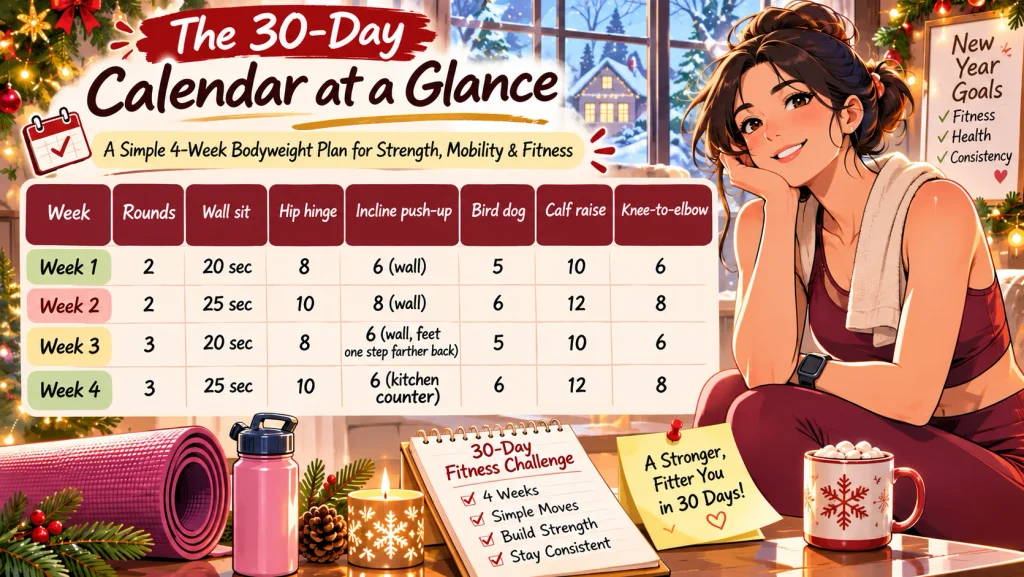
The 30-Day Calendar at a Glance
If you only read one section, make it this one. Every day is listed, along with the exact numbers for each week. The plan uses six moves: wall sit, hip hinge, incline push-up, bird dog, calf raise, and standing knee-to-elbow. The next section shows how to do each one.
- Reps day: the six moves at a normal pace, using that week’s numbers.
- Timed day: the six moves against a clock. You work for a set number of seconds and rest for the remainder of each minute.
- Slow day: the same moves at a slower pace, taking three seconds to lower on every rep, with two fewer reps than a reps day.
- Walk day: a walk with a few brisk stretches. On the brisk parts you should be breathing harder but still able to talk in short sentences.
- Rest day: nothing planned. A stroll is fine.
Times below include a 2-minute warm-up and a 1-minute cool-down, both described in the moves section.
How many reps, rounds and seconds should a beginner do each week?
Go straight from one move to the next, and rest 45 seconds between rounds. On bird dog and knee-to-elbow the number is per side. For the slow day, take off two reps from every move (one per side on bird dog and knee-to-elbow, five seconds off the wall sit).
| Week | Rounds | Wall sit | Hip hinge | Incline push-up | Bird dog | Calf raise | Knee-to-elbow |
|---|---|---|---|---|---|---|---|
| 1 | 2 | 20 sec | 8 | 6 (wall) | 5 | 10 | 6 |
| 2 | 2 | 25 sec | 10 | 8 (wall) | 6 | 12 | 8 |
| 3 | 3 | 20 sec | 8 | 6 (wall, feet one step farther back) | 5 | 10 | 6 |
| 4 | 3 | 25 sec | 10 | 6 (kitchen counter) | 6 | 12 | 8 |

Week 1 (Days 1 to 7): Learn the moves
This week is about form. The numbers are small on purpose. If a day feels too easy, leave it alone. Week 2 will raise them for you.
| Day | Type | What to do | About |
|---|---|---|---|
| 1 | Test + first round | Do the starting test (see “Before Day 1” below). Then one round of the six moves at the Week 1 numbers, and a 5-minute easy walk. | 20 min |
| 2 | Walk day | 20 minutes of easy walking. You should be able to chat without effort. | 20 min |
| 3 | Timed day | Warm up. Two rounds of the six moves, 20 seconds of work and 40 seconds of rest per move. Cool down. | 16 min |
| 4 | Rest day | Nothing planned. | – |
| 5 | Slow day | Warm up. Two rounds at the Week 1 numbers, slow-day style. Cool down. | 12 min |
| 6 | Walk day + stretch | 15 minutes of easy walking, then the 5-minute stretch. | 20 min |
| 7 | Rest day | Nothing planned. | – |

Week 2 (Days 8 to 14): A Few more reps, a little more speed
Same moves, slightly bigger numbers. The walk adds three short brisk stretches, so you get a first taste of working harder.
| Day | Type | What to do | About |
|---|---|---|---|
| 8 | Reps day | Warm up. Two rounds at the Week 2 numbers. Cool down. | 14 min |
| 9 | Walk day | Walk 5 minutes easy. Then three rounds of 1 minute brisk, 3 minutes easy. Finish with 3 minutes easy. | 20 min |
| 10 | Timed day | Warm up. Two rounds, 30 seconds of work and 30 seconds of rest per move. Cool down. | 16 min |
| 11 | Rest day | Nothing planned. | – |
| 12 | Slow day | Warm up. Two rounds at the Week 2 numbers, slow-day style. Cool down. | 13 min |
| 13 | Walk day + stretch | 15 minutes of easy walking, then the 5-minute stretch. | 20 min |
| 14 | Rest day | Nothing planned. | – |

Week 3 (Days 15 to 21): Add a third round
This is the week it usually starts to feel like work. The rep numbers drop back a little so the extra round isn’t a big jump. Push-ups get harder by moving your feet back a step.
| Day | Type | What to do | About |
|---|---|---|---|
| 15 | Reps day | Warm up. Three rounds at the Week 3 numbers. Cool down. | 17 min |
| 16 | Walk day | Walk 5 minutes easy. Then five rounds of 1 minute brisk, 2 minutes easy. | 20 min |
| 17 | Timed day | Warm up. Two rounds, 35 seconds of work and 25 seconds of rest per move. Cool down. | 16 min |
| 18 | Rest day | Nothing planned. | – |
| 19 | Slow day | Warm up. Three rounds at the Week 3 numbers, slow-day style. Cool down. | 17 min |
| 20 | Walk day + stretch | 15 minutes of easy walking, then the 5-minute stretch. | 20 min |
| 21 | Rest day | Nothing planned. | – |

Week 4 (Days 22 to 30): Put it together, then retest
The last full week has the biggest numbers in the plan, and the push-up moves to your kitchen counter. Day 29 is deliberately easy so your legs are fresh for the retest on Day 30.
| Day | Type | What to do | About |
|---|---|---|---|
| 22 | Reps day | Warm up. Three rounds at the Week 4 numbers. Cool down. | 19 min |
| 23 | Walk day | Walk 5 minutes easy. Then three rounds of 3 minutes brisk, 2 minutes easy. | 20 min |
| 24 | Timed day | Warm up. Two rounds, 40 seconds of work and 20 seconds of rest per move. Cool down. | 16 min |
| 25 | Rest day | Nothing planned. | – |
| 26 | Slow day | Warm up. Three rounds at the Week 4 numbers, slow-day style. Cool down. | 19 min |
| 27 | Walk day + stretch | 15 minutes of easy walking, then the 5-minute stretch. | 20 min |
| 28 | Rest day | Nothing planned. | – |
| 29 | Easy walk | 20 minutes of easy walking. No circuit today. | 20 min |
| 30 | Retest | Repeat the starting test in the same order. Then walk 10 minutes, slowly, and enjoy it. | 20 min |
Add it up and you’re moving roughly 85 to 95 minutes a week. The three strength days cover the “muscle-strengthening on two or more days” part of the federal guidelines. The walks are where you start building toward the 150 minutes of moderate aerobic activity a week those same guidelines recommend. The section on what to do after Day 30 shows how to get there.
The Six Moves
You need a wall, a kitchen counter or sturdy table (Week 4 only), a towel or carpet for the floor move, and a phone timer. Every move is quiet and has no jumping, so a downstairs neighbor won’t hear a thing.
Warm-up and cool-down: For the warm-up (2 minutes), march in place for 1 minute, then do 30 seconds of arm circles and 30 seconds of hip circles. For the cool-down (1 minute), walk in place slowly and breathe out long. Add a calf stretch against the wall if your calves feel tight.
The 5-minute stretch: Used on the Walk + stretch days. Spend about a minute on each: cat-cow on your hands and knees (round your back, then lower it, slowly, 10 times), a seated hamstring stretch with one leg straight, a doorway chest stretch with your forearm on the frame, child’s pose, and a kneeling hip stretch with a towel under the knee. If getting down on the floor is hard, stretch your hamstrings with your heel on a low step, and do the chest stretch standing.

1) Wall sit
Stand with your back flat against a wall and your feet about two feet out, hip-width apart. Slide down until your knees are bent as far as you can comfortably hold, and stay there. Thighs level with the floor is a long-term goal, not where you start. A shallow slide counts. Keep your knees over your ankles and breathe normally. When 25 seconds feels easy, slide a little lower. If your knees complain sharply, go shallower or skip it that day.

2) Hip hinge
Stand with your feet hip-width apart, knees slightly soft, and hands on your hips. Push your hips straight back as if you’re closing a car door with your backside, letting your chest tip forward with a flat back. Stop when you feel a stretch along the backs of your thighs, then squeeze your glutes to stand. Your knees should barely bend, since the motion comes from the hips. If your back starts to round, you’ve gone too far. Sliding your hands down your thighs as you go helps you find the right depth. Once it’s easy, fold your arms across your chest and pause for two seconds at the bottom.

3) Incline push-up
Put your hands on the wall at shoulder height, a little wider than your shoulders, and walk your feet back until your body is one straight, slightly angled line. Bend your elbows to bring your chest toward the wall, then press away. The plan makes it harder in two steps: in Week 3 your feet move one step farther back, and in Week 4 your hands go on the edge of a kitchen counter, which lowers the angle. Both versions are quiet. If your wrists bother you, rest your forearms on the wall and press your chest forward and back a few inches instead.

4) Bird dog
Get on your hands and knees, hands under your shoulders and knees under your hips. Reach one arm forward and the opposite leg straight back, hold for two seconds, and switch sides. The point is to keep your back still. Picture a cup of water balanced on your lower back. If that’s too much, lift only the legs or only the arms for the first few days. A folded towel under your knees helps on hard floors, and fists or forearms take pressure off sore wrists. If kneeling is hard, do a standing version with one hand on the wall and reach the opposite arm and leg out.

5) Calf raise
Stand an arm’s length from the wall with your fingertips resting on it and your feet hip-width apart. Rise onto the balls of your feet, pause for one second at the top, and lower slowly. Keep your weight over the big toe side of your foot so your ankles don’t roll outward. By Week 4, if it’s easy, try it on one foot at a time with your fingertips on the wall.

6) Standing knee-to-elbow
Stand tall with your hands behind your head. Lift one knee toward the opposite elbow, bringing the two toward each other, then switch. It’s your cardio move, so keep it moving without rushing, and keep your chest up. If reaching your elbow is too much, tap your hand to the opposite thigh instead. To keep it quiet, place your foot down softly each time.

Before Day 1: Setup and the Starting Test
Most plans tell you to step on a scale and take photos. This one asks you to measure what you can do. Body weight shifts for reasons that have nothing to do with a four-week plan, but a wall sit time doesn’t lie. The setup takes five minutes and the test takes about ten.
↬ The five-minute setup (Day 0)
- Pick a start date: A Monday works best. It puts your rest days on Thursday and Sunday.
- Pick a time slot you can protect on strength days, and set a phone reminder for it.
- Clear a wall spot: You need enough floor to lie on your back and a clear stretch of wall.
- Write the five active days on a calendar you see every day. A fridge calendar works.
- Open a note on your phone and title it “Day 1 test.” You’ll fill it in next.
↬ The starting test
Do the 2-minute warm-up first. Rest two minutes between each check, then do these four in order:
- Wall sit: Slide down to a depth you can repeat and hold until you have to stop. Stop at 60 seconds if you get there. Note how low you went so you can match it on Day 30.
- Single-leg balance: Stand next to the wall with your fingertips close but not touching. Lift one foot a few inches and time how long you hold until your foot touches down or you grab the wall. Stop at 30 seconds. Test both legs and write down both numbers.
- Knee-to-elbow in 30 seconds: Hands behind your head. Count every knee lift in 30 seconds.
- A 5-minute walk: Walk at a comfortable pace, then rate how hard it felt from 1 to 10.
On Day 30, repeat the test in the same order and with the same depth and route. Here’s a made-up example to show the format (it isn’t a typical result and it isn’t a promise):
| Check | Day 1 (example) | Day 30 (example) |
|---|---|---|
| Wall sit hold | 25 seconds | 45 seconds |
| Single-leg balance (left / right) | 12 / 9 seconds | 22 / 18 seconds |
| Knee-to-elbow in 30 seconds | 14 | 22 |
| 5-minute walk effort (1 to 10) | 6 | 4 |
Do the balance check next to the wall, so you can catch yourself. Stop any check if you feel dizzy, get chest pain, or feel sharp pain in a joint. If you have a health condition, an injury, or you’re pregnant, talk to your doctor before you start. This plan is general fitness information, not medical advice.

How Hard this Should Feel
For walks and knee-to-elbow, use the talk test from the federal physical activity guidelines. If you’re breathing harder but can still carry on a conversation easily, you’re at a moderate effort, which is the target for the brisk stretches. If you can only get out a few words between breaths, slow down. On the easy stretches you should be able to talk without thinking about it.
On strength moves, finish each set feeling like you could have done two or three more good reps. If your form falls apart before the last rep, make that move easier.
Some muscle soreness a day or two after the first few sessions is common and fades. Sharp pain or pain in one joint is different. Stop that move, and if it keeps happening, check with a doctor or physical therapist. In Week 1, when in doubt, do less.

IF You Miss a Day: The 4 of 5 Rule
You will miss a day. Most people do, usually in the second or third week, and it’s the main reason challenges fall apart. This plan uses the week, not the single day, as the unit that counts.
The 4-of-5 rule: each week has five active days. If you finish four of them, the week counts as complete. Don’t make up the one you skipped, and move on to next week’s numbers on schedule.
- You finish three or fewer active days: repeat that week’s numbers before moving on. If this pushes the end of the plan past Day 30, do the Day 30 retest whenever you finish.
- You miss four or more days in a row: restart the week you were in. You don’t need to go back to Day 1, because you already know the moves.
- You’re out for more than a week (illness, travel, a family emergency): go back one full week when you return.
Here’s a real-world version. Day 10 is a timed day, and your child wakes up sick. You skip it. You finish Days 8, 9, 12, and 13 that week, which is four of five, so the week counts. You move to the Week 3 numbers on Day 15 as planned. That’s fine, because skipping one workout out of 30 doesn’t change what the plan does for you.
Two short versions that still count
On a rough day or a packed one, use one of these. Either counts as an active day.
- The 5-minute bad-day version: march in place for 2 minutes, then do one set of hip hinges (8), a 15-second wall sit, and a 6-rep wall push-up. That’s it.
- The 10-minute busy-day version: one warm-up minute, then one round at that day’s numbers, then a 1-minute cool-down. On a walk day, take a 10-minute walk.
Even short bouts of activity add up, according to the federal Move Your Way guidance, so a five-minute day is better than a zero.

Doing This in January
In much of the US the sun sets around 5 p.m. or earlier in January, so a lunchtime or morning slot for strength days saves you from fighting the dark evening. Walk days are the flexible ones. If it’s mild, go outside in layers (here’s what to wear for cold-weather walks), and if it’s icy, walk laps in a hallway, up and down a staircase, or around a mall. The strength days need only a patch of wall and floor. For a full indoor routine built for cold rooms and small apartments, see the winter indoor workout guide.

What to do After Day 30
Start by comparing your Day 30 test to your Day 1 numbers. They’ll tell you more than the mirror.
Don’t treat Day 30 as the finish line for the habit. In a well-known study of habit formation, it took people about 66 days on average for a new behavior to feel automatic, and it varied a lot from person to person. Thirty days is a good start, not the end.
You have three reasonable next steps:
- Repeat from Week 3. Run the plan again at the Week 3 numbers. You know the moves, so this goes faster than it did the first time.
- Keep the strength days and build your walks. The federal guidelines recommend 150 minutes of moderate aerobic activity a week, plus muscle-strengthening on at least two days. Your three strength days cover the second part. For the first, walk four days a week for 35 to 40 minutes at an effort where you can still talk. That lands you between 140 and 160 minutes.
- Swap in a different circuit. If you’d like a change from these six moves, the winter indoor routine uses five other moves you can rotate in.
More plans like this are in the Fitness Challenges & Plans section.
Questions Beginners Ask
No. The plan runs on any 30 days, and nothing in it depends on the date. Starting on a Monday gives you rest days on Thursday and Sunday.
For a first month, yes. The goal is to build the habit and learn the moves, and federal guidance says even short bouts of activity count. The “after Day 30” section shows how to build up from here.
Repeat that week before moving on. Three days is a start, but the plan only counts a week as complete at four of five. If you’re stuck at three for several weeks, a three-day-a-week plan might suit your schedule better, and that’s a fair choice.
How this Plan was Built
The structure follows the Physical Activity Guidelines for Americans: strength work on at least two days a week, plus walking that builds toward the weekly aerobic target. Each week adds a little (more reps, a third round, longer work time, a lower push-up angle), so the jumps stay small. The six moves are basic bodyweight exercises, each with an easier and a harder version.
Sources
- CDC, “Adult Activity: An Overview” (weekly aerobic activity and muscle-strengthening guidelines): https://www.cdc.gov/physical-activity-basics/guidelines/adults.html
- U.S. Department of Health and Human Services, Office of Disease Prevention and Health Promotion, Move Your Way (the talk test, and short bouts of activity adding up): https://odphp.health.gov/moveyourway/activity-planner/why-these-goals
- Lally, van Jaarsveld, Potts and Wardle, “How are habits formed: Modelling habit formation in the real world,” European Journal of Social Psychology (average of about 66 days): https://doi.org/10.1002/ejsp.674
This article is general fitness information, not medical advice. Check with your doctor before starting a new exercise plan, especially if you have a health condition or injury, or you’re pregnant.
Pingback: New Year Healthy Habits Checklist: 11 Habits, Pick Only 3