

Best Walking Shoes For Women: Pick By Fit, Budget And Miles
Walking shoes cost approx. around $155 to $175 at full price, and the wrong pair means sore feet or a trip back to the store. You don’t need to compare fifty shoes to avoid that. Five current women’s pairs cover the most common walking jobs: the Hoka Clifton 11 for daily pavement miles, the Brooks Adrenaline GTS 25 for a steady, guided ride, the New Balance 1080 v15 for the softest feel in standard and wide widths, the Hoka Bondi 9 for hours on your feet, and the On Cloud 6 for a light pair you can get on fast in warm weather.
Which one is yours comes down to three questions: how you walk, how wide your foot is, and what you’ll pay. The sections below answer each one, and the specs sit side by side so you can check every number against the product page before you spend anything.

Which Pair Fits You?
Start with how you walk. The CDC’s weekly target for adults is 150 minutes of moderate activity, and brisk walking counts, so for many people this is a pair worn almost every day. Find the line that sounds like you.
| If this sounds like you | Start with | Why |
|---|---|---|
| Errands and neighborhood loops on pavement, most days | Hoka Clifton 11 | Maximum cushion at about 8.2 oz |
| Long walks, and you want the ride to feel steady, not squishy | Brooks Adrenaline GTS 25 | A stability shoe with mid-level cushion |
| You want the softest, lightest feel | New Balance 1080 v15 | Listed as extra soft at 7.3 oz |
| You’re on your feet for hours: a shift, a travel day, a theme park | Hoka Bondi 9 | Maximum cushion for long hours |
| You live somewhere warm and want shoes you can put on fast | On Cloud 6 | Speed laces and a wide opening, about 7.6 oz |
| Your foot is wide | GTS 25, 1080 v15 or Bondi 9 | All three list standard (B) and wide (D) widths |
| Your limit is $100 | Wait for a sale on one of these | See the price section below |
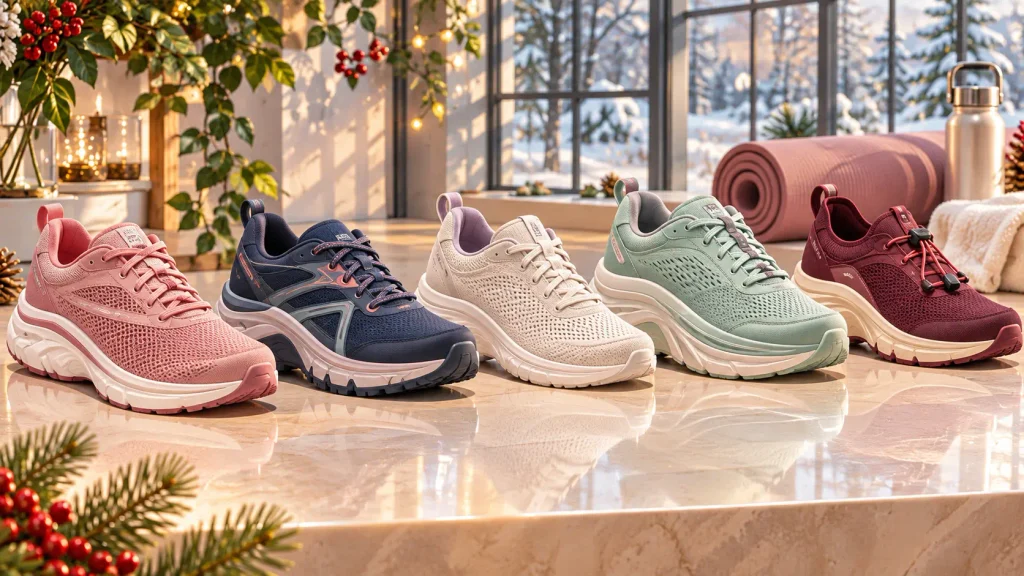
The Five Pairs Side by Side
These are the numbers to hold up against a product page. Heel drop is how much taller the heel sits than the front of the shoe. A lower number feels flatter, a higher one feels like a slight heel. Each seller uses its own cushion scale, so treat those labels as rough guides.
| Shoe | Price seen (approx) | Cushion, as the seller lists it | Heel drop | Weight, one shoe | Women’s widths |
|---|---|---|---|---|---|
| Hoka Clifton 11 | $155 | Maximum, neutral | 8 mm | 8.2 oz, per REI | Check the Width menu on the product page |
| Brooks Adrenaline GTS 25 | $155 | Mid-level, stability | 10 mm | 9.5 oz, per Road Runner Sports | Standard (B) and wide (D) |
| New Balance 1080 v15 | $170 list | Extra soft, neutral | 6 mm | 7.3 oz (208 g), per New Balance | Standard (B) and wide (D) |
| Hoka Bondi 9 | $175 | Max cushion, neutral | 5 mm | 9.3 oz, per Road Runner Sports | Standard (B) and wide (D); extra wide at some retailers |
| On Cloud 6 | $125 (was $160) | CloudTec cushioning, no scale listed | 8 mm | 216 g, about 7.6 oz, per On | Check the Size & Fit tab |
A Closer Look at Each Pair
1) Hoka Clifton 11: the all-rounder for pavement
REI lists it as a neutral shoe with maximum cushioning, an 8 mm drop and a half-pair weight of 8.18 oz. Hoka describes a new engineered mesh upper, a softer open-cell sockliner and a MetaRocker shape that helps your foot roll forward. In plain terms: plush, fairly light, and easy to wear all day. It lists at $155. The open question is width, so check the Width menu on the product page before you assume it comes in wide.
2) Brooks Adrenaline GTS 25: the steadier ride
Road Runner Sports files it as a stability shoe with mid-level cushion, a 10 mm drop and a weight of 9.5 oz. Brooks’ GuideRails system is built to limit excess movement at the hips and knees rather than lock your foot into a rigid position, and the DNA LOFT v3 foam adds 3 mm up front and 1 mm in the heel over the last version. It lists at $155 in standard (B) and wide (D). Expect a less plush feel than the Clifton, 1080 or Bondi, and a slightly heavier shoe than the rest.
3) New Balance 1080 v15: the softest feel
New Balance lists it as extra soft with neutral support, 208 g (7.3 oz) and a 6 mm drop. The foam is Infinion, which New Balance says improves cushioning and energy return, and the upper is a perforated mesh. It comes in B and D. At $169.99 on the brand’s own page, it’s the second most expensive of the five, and that page marked it as excluded from promotions when we looked, so any discount will come from retailers. Choose it for softness. Skip it if very soft shoes feel unsteady to you.
4) Hoka Bondi 9: built for long hours
Road Runner Sports lists it as neutral with max cushion, a 5 mm drop and a weight of 9.3 oz. Hoka says it adds 2 mm of stack height over the Bondi 8, with a new foam, a 3D-molded collar and a structured knit upper in place of mesh. It lists at $174.95 in standard and wide, with extra wide at some retailers. It’s the priciest of the five, so it earns its place when you’re standing or walking for hours, not for a quick loop around the block.
5) On Cloud 6: the easy-on pair for warm days
On lists the Cloud 6 with speed lacing, an 8 mm drop and a weight of 216 g, about 7.6 oz. The features call out CloudTec cushioning, a Speedboard, a new sockliner for easy step-in and a wider opening. It’s breathable, which suits warm weather and does little for cold or rain, though On’s page points to a separate waterproof range. When we checked, On’s U.S. page also labeled the Cloud 6 as last season, which is why you may see it marked down.
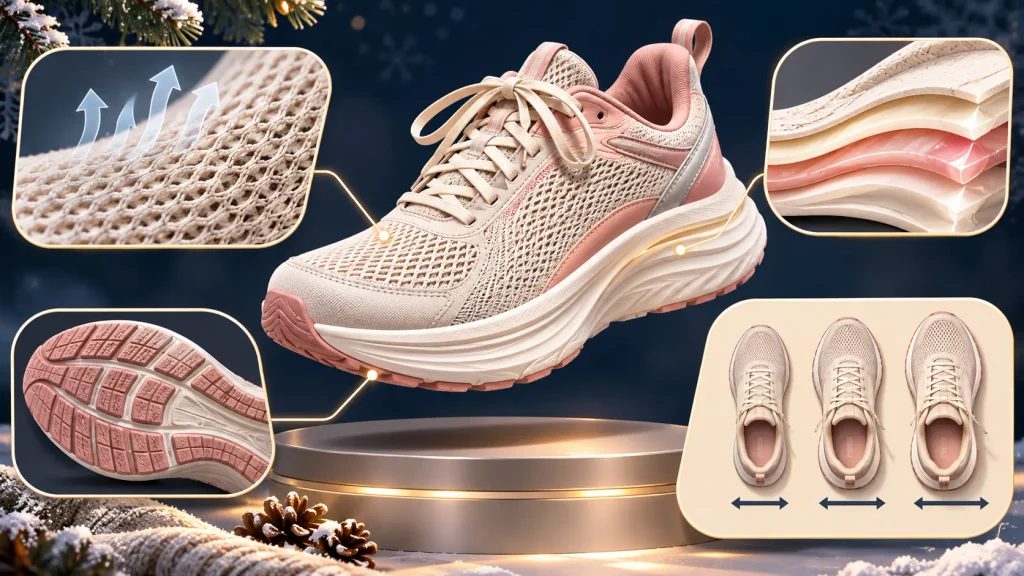
Check These Before You Trust a Spec Sheet
When we compared listings for these shoes, the same pair didn’t always show the same numbers. Four things to watch for.
⇝ One shoe, three weights: Listings for the women’s 1080 v15 give 7.1, 7.3 and 7.8 oz. Some of that is size, some is whether laces are counted, and some is whether the number is for one shoe or a pair. Compare weights only when they say “per shoe” and name the size.
⇝ Check the width menu, not the description: Width options vary by listing. The product page’s Width menu is the only reliable answer, especially for the Clifton 11. If the menu shows only one option, that’s all that exists in that colorway.
⇝ Two Bondis with nearly the same name: The Bondi 9 is the road shoe in the table above. Hoka also sells a slip-resistant work version with “SR” in the name. They’re different shoes. For long shifts on slick floors, look for SR on the page. For sidewalks, you want the Bondi 9.
⇝ “Last season” isn’t a flaw: Brands release a new version about once a year, and older ones get marked down. If a model you like drops in price, that’s usually why. Check that your size and width are still in stock, since those go first.

What You’ll Pay, and What it Costs Per Mile
The most common rule of thumb is that a walking shoe lasts 300 to 500 miles. Divide the price by those miles and the gap between the five shrinks.
| Shoe | List price (approx) | Cost per mile over 300 to 500 miles |
|---|---|---|
| Hoka Clifton 11 | $155 | $0.31 to $0.52 |
| Brooks Adrenaline GTS 25 | $155 | $0.31 to $0.52 |
| On Cloud 6 | $160 | $0.32 to $0.53 |
| New Balance 1080 v15 | $170 | $0.34 to $0.57 |
| Hoka Bondi 9 | $175 | $0.35 to $0.58 |
The cheapest and priciest of these differ by roughly 4 to 7 cents a mile. A pair that fits is worth far more than that, and a pair you stop wearing costs the full price. So spend your effort on fit, not on shaving $20 off the tag.
If you want to pay less, sales happen. When we checked, the Cloud 6 showed $125 and the Adrenaline GTS 25 showed $125 at one running retailer. Those prices come and go within days, so treat them as a sign of what’s possible, not what you’ll pay tomorrow. None of these five is a sub-$100 shoe. If $100 is your limit, wait for older colors or last-season models, which is where discounts usually land, and check that your size and width are still in stock.
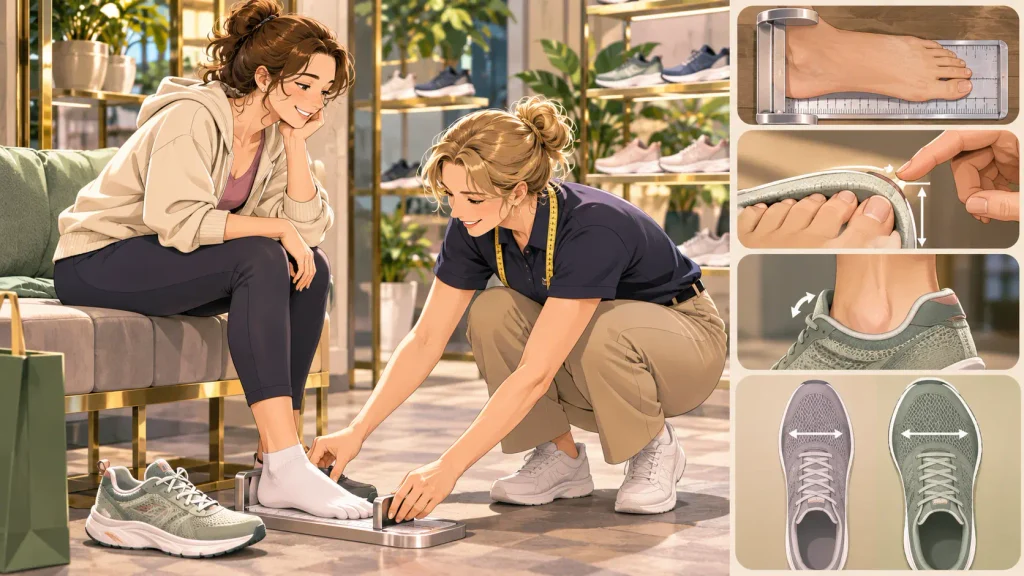
Sizing and Width for Women, in Plain Terms
US women’s widths run on letters. B is standard, D is wide, and brands that offer extra wide usually label it 2E. A women’s size 8 is typically a men’s 6.5, so you can sometimes buy the men’s or unisex version on sale if you subtract about a size and a half. Check the brand’s size chart before you do it, because widths don’t convert the same way.
For fit, try shoes on late in the day, when feet have swelled a bit, and leave about a thumb’s width between your longest toe and the front of the shoe. Many people go up half a size for long walking days. Check the width before you add length, because a shoe that’s too narrow feels short.
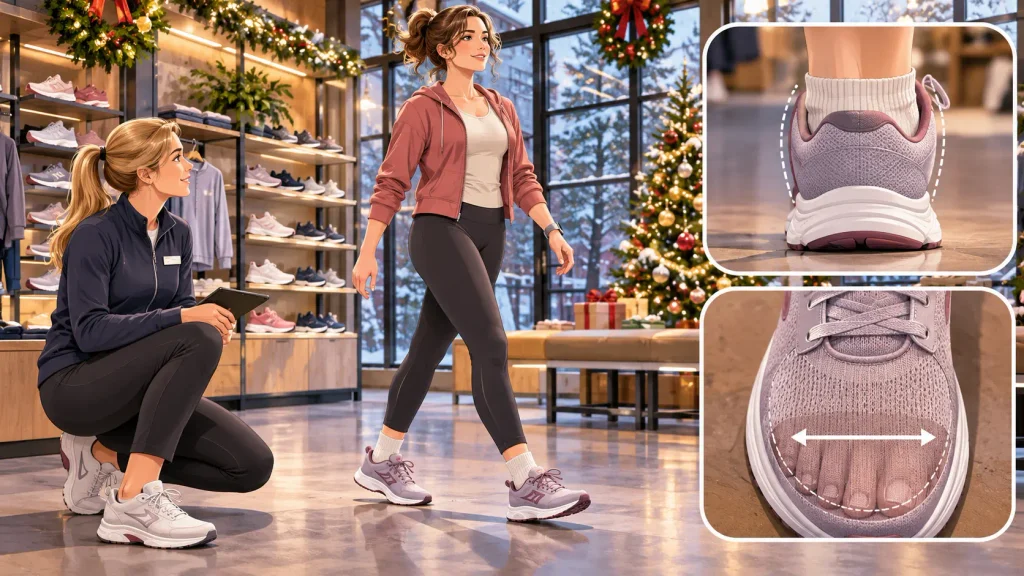
How to Try Shoes on Without Wasting $155
The simplest route is a specialty running or shoe store, where staff can watch you walk. Take the socks you’ll wear and the insoles you use now, and walk on a hard floor, not just carpet. Check that your heel doesn’t slide up as you walk and that your toes have room at the front.
Once you know a model and size that work, buying other colors online on sale is a fair shortcut. Before you wear anything outdoors, read the return policy, because some retailers only take back shoes that look unworn. If you’re shopping for someone else, our fitness gifts for women list explains why a shoe-fitting gift card beats guessing a pair.

Rain, Travel Days and the Office
⇝ Rain and cold
Breathable mesh is great in summer and gives little warmth or water protection. If you walk through winter, look for a waterproof version of a shoe you like, or a leather or water-resistant upper, and check the product page for the word “waterproof” before you order. For clothing and layers, see our walking, running and outdoor fitness guides.
⇝ Travel days and theme parks
Take a common case: a yearly theme-park trip, mostly concrete paths, a budget of $100 to $150. Most pairs here list above that, so the practical route is a sale price on last season’s Cloud 6 or the Adrenaline GTS 25. Whatever you buy, break it in with a few short walks first, so a new pair doesn’t meet its first 15,000 steps on vacation. If you can, bring two pairs and switch halfway so each one airs out. If most of your steps happen at home, the same fit rules apply to a walking pad, and we have a separate guide to walking pads for small spaces.
⇝ The office
Pick a dark or neutral colorway. White mesh shows scuffs quickly, and the Cloud 6’s slim shape is the easiest of these to wear with trousers.
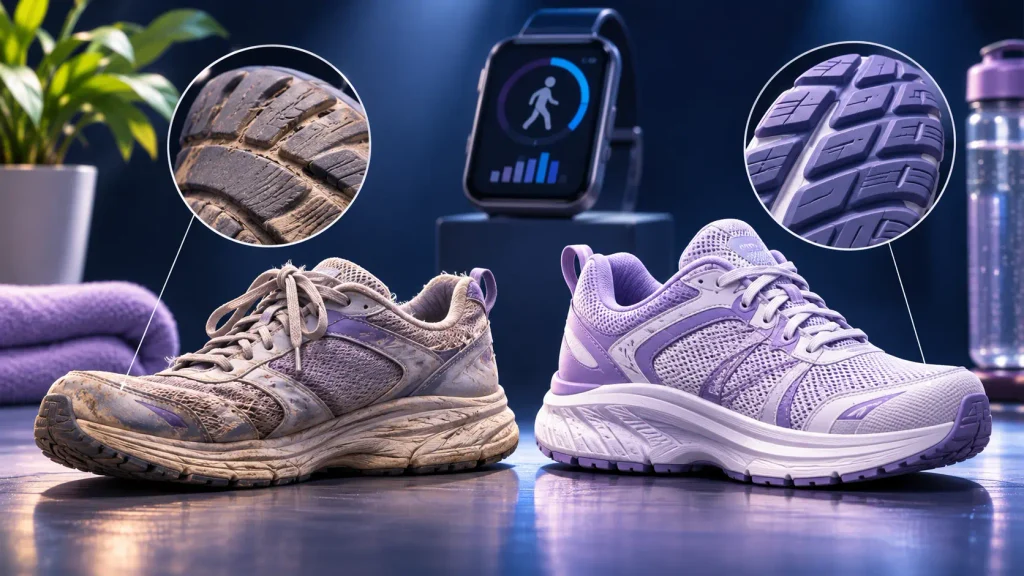
When to Replace Them
Your watch or phone already logs distance, so you can work out when a pair will hit 300 to 500 miles. At four weekly mileages, that looks like this:
| Miles per week | Time to reach 300 to 500 miles |
|---|---|
| 10 | about 7 to 11.5 months |
| 15 | about 4.5 to 7.5 months |
| 20 | about 3.5 to 6 months |
| 30 | about 2.5 to 4 months |
The calendar is a guess. If the tread has gone smooth, the shoe feels flat, or it folds in half with no resistance, replace it sooner. Our guide on using fitness tech to stay consistent covers setting up the distance tracking.

The Pair to Start With
If you walk on pavement and want one pair, try the Hoka Clifton 11. If very soft shoes feel wobbly, try the Brooks Adrenaline GTS 25. If you want the softest feel and need a wide fit, try the New Balance 1080 v15. If you’re on your feet for hours, try the Hoka Bondi 9. If you live somewhere warm and want an easy-on pair, try the On Cloud 6 on sale. If your limit is $100, wait for a sale on one of these.
These picks come from published specs and fit logic, not from our own testing, so keep the return window open for the first walk.
Questions That Come Up
Yes. Most of the shoes on this page are sold as running shoes, and they work for walking. Judge them by fit, cushioning and how they feel on your foot, not by the label.
Many people go half a size up for long walking days because feet swell. Check width first, then length, and try shoes on late in the day before you decide.
It depends on you. Very soft shoes can feel unsteady to some walkers. If that’s you, try the Adrenaline GTS 25. If you want the most cushioning, try the Bondi 9.
Some people walk long, flat, dry days in sport sandals. None of the shoes here are sandals, so we don’t rank them.
See a podiatrist or your doctor. This page is a shopping comparison and can’t diagnose anything.
Where These Numbers Come From
Prices and specs were checked on November 17, 2026, and change often. Spec links go to brand or retailer pages. Click through before you buy.
- CDC: adult physical activity guidelines
- Hoka Clifton 11, women’s (REI) and Road Runner Sports
- On Cloud 6, women’s (On)
- Hoka Bondi 9, women’s (Road Runner Sports)
- Brooks Adrenaline GTS 25, women’s (Road Runner Sports)
- New Balance 1080 v15, women’s (New Balance)
Disclosure: none of the product links on this page are affiliate links, and we earn no commission if you buy. No brand or retailer paid for a place on this list. Kheltechie earns money from display ads, which don’t depend on which shoes we cover.