

Fall Cardio Workout: Simple Low-Impact Options for Beginners
Cardio doesn’t have to mean jumping, sprinting, or finishing every workout completely exhausted. If you’re getting back into exercise this fall or you’re simply looking for a gentler way to improve your fitness, low-impact cardio can be a practical place to start.
Low-impact activities reduce the amount of repetitive impact placed on your joints compared with activities such as running and jumping, while still allowing you to work your cardiovascular system.
This guide covers simple beginner-friendly options you can do at home, outdoors, at the gym, or with minimal equipment.
Also Read :- https://kheltechie.in/fall-fitness-motivation-10-ways-to-stay-consistent/

What Is Low-Impact Cardio?
Low-impact cardio generally involves keeping at least one foot in contact with the ground or using movements that reduce repetitive impact.
Examples include:
- Walking
- Cycling
- Stationary cycling
- Swimming
- Water exercise
- Elliptical training
- Low-impact aerobic workouts
- Marching in place
Low-impact doesn’t mean “no effort.”
You can still increase your heart rate and challenge your cardiovascular system while choosing movements that feel more manageable.

1. Brisk Walking
Walking is one of the simplest ways to begin.
You can do it:
- Outdoors
- On a treadmill
- Around your neighborhood
- At a local park
- During a lunch break
- After dinner
Beginner idea
Start with:
- 20–30 minutes of comfortable-to-brisk walking
- Then gradually increase your pace or duration as your fitness improves.
- Walking can also become your foundation for a broader fall fitness routine.

2. Marching in Place
Don’t have time to go outside?
Try marching in place.
Stand tall and alternate lifting your knees while moving your arms naturally.
Try:
- 30 seconds marching
- 30 seconds easy recovery
- Repeat for several rounds.
You can make the movement easier or more challenging depending on your pace.
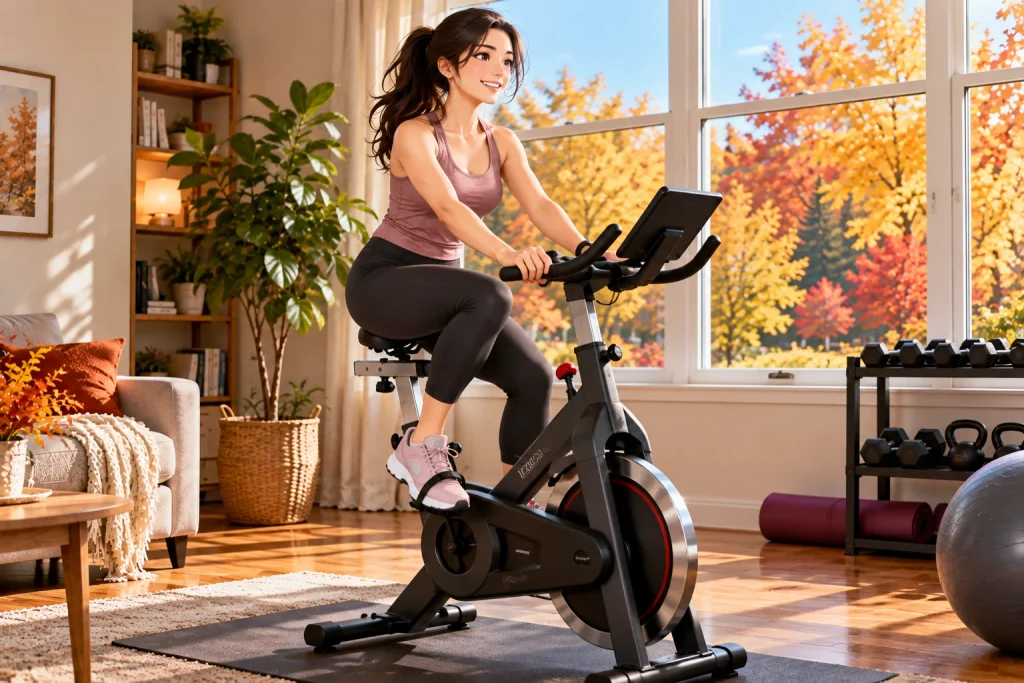
3. Stationary Cycling
A stationary bike provides a low-impact way to work your cardiovascular system.
Start with a comfortable resistance and steady pace.
Beginner session:
5-minute easy warm-up
→ 10–15 minutes comfortable cycling
→ 5-minute easy cooldown
As your fitness improves, gradually increase your total cycling time.

4. Outdoor Cycling
Fall can be a great time to take your cardio outdoors in areas with comfortable weather.
A relaxed bike ride can combine cardiovascular exercise with time outside.
Keep the intensity appropriate for your fitness level and choose safe routes and conditions.

5. Elliptical Training
An elliptical machine can provide a low-impact cardio option at the gym.
Because the feet remain on the machine’s pedals, it avoids the repeated impact associated with running.
Beginner approach:
- Start with:
5-minute easy warm-up - Then:
10–15 minutes at a manageable pace - Finish with:
5-minute cooldown

6. Swimming
Swimming is another low-impact cardiovascular activity.
The water supports your body while you move, making swimming or water-based exercise an option for people who enjoy being in the pool.
Start with short intervals and rest as needed.
You don’t need to swim continuously for a long period to begin building a routine.

7. Low-Impact Step Workout
A simple step routine can raise your heart rate without jumping.
Try:
Step side to side
→ March in place
→ Step forward and back
→ Side step + arm movement
Perform each movement for a short interval, then recover.
Repeat for several rounds based on your fitness level.

8. Dance-Based Cardio
Put on music and move.
Dancing can be a fun way to add cardiovascular activity without following a traditional workout.
Keep movements low-impact by:
- Avoiding jumps
- Keeping one foot grounded
- Using side steps
- Marching
- Moving your arms
- Adjusting the pace
The goal is to find movement you actually enjoy.

9. Low-Impact Cardio Circuit
You can combine several movements into one beginner-friendly circuit.
Try this:
- March in place — 45 seconds
- Side steps — 45 seconds
- Step forward/back — 45 seconds
- Low-impact dance — 45 seconds
- Rest — 30 seconds
Repeat for 2–4 rounds depending on your current fitness level.
You can shorten the intervals if you’re just starting.

10. Fall Outdoor Walking Workout
Take advantage of the season with a simple walking interval workout.
Example:
- 5 minutes: Easy walk
- 5 minutes: Brisk walk
- 2 minutes: Easy recovery
- 5 minutes: Brisk walk
- 5 minutes: Easy cooldown
You can adjust the duration according to your fitness level.
This gives you a simple way to introduce changes in pace without running.

How Hard Should Beginner Cardio Feel?
A useful way to judge moderate-intensity activity is the talk test.
During moderate activity, you should generally be able to talk but not sing.
You don’t need to make every cardio session extremely difficult.
For beginners, the priority should be:
Comfortable → Consistent → Gradually More Challenging
rather than:
Hard → Exhausting → Burned Out
Beginner 20-Minute Low-Impact Cardio Workout
Here’s a simple option you can do without special equipment.
- 0–5 minutes
Easy marching + side steps - 5–10 minutes
Brisk marching + step-touch - 10–15 minutes
Alternating side steps + forward/back steps - 15–18 minutes
Comfortable faster-paced movement - 18–20 minutes
Slow walking/marching cooldown
Adjust the movements, pace, and duration based on your current ability.
3 Beginner Cardio Mistakes to Avoid
- Starting Too Hard
You don’t need to prove your fitness during your first workout.
Start at a manageable intensity. - Skipping the Warm-Up
Spend a few minutes gradually increasing your movement before harder activity. - Increasing Everything at Once
Don’t simultaneously increase duration, frequency, speed, and intensity.
Change one factor gradually.
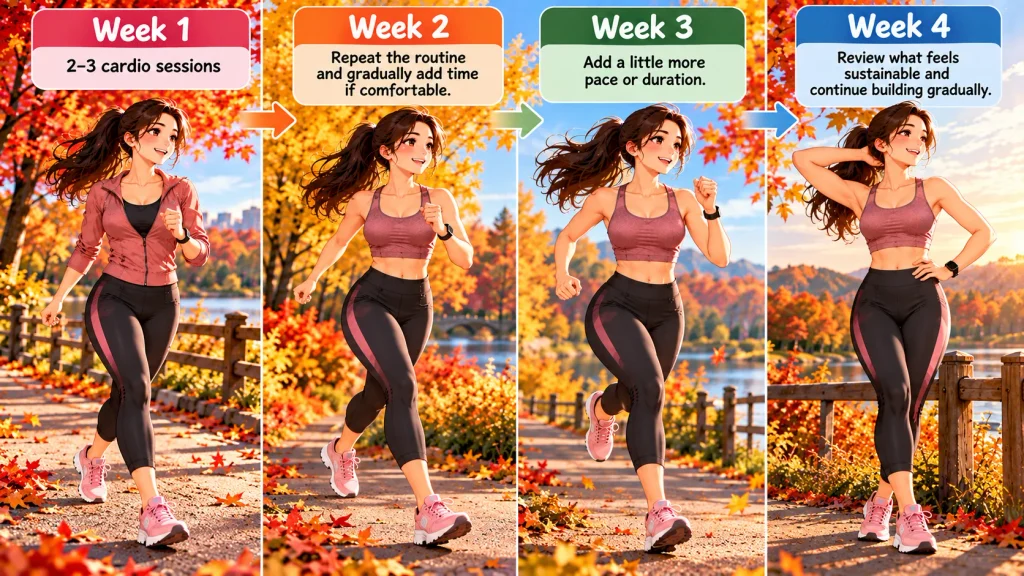
How to Build Your Fall Cardio Routine
You can start with:
- Week 1
2–3 cardio sessions - Week 2
Repeat the routine and gradually add time if comfortable. - Week 3
Add a little more pace or duration. - Week 4
Review what feels sustainable and continue building gradually.
Your exact schedule should reflect your current fitness level and other physical activity.
When Low-Impact Cardio May Be a Better Starting Point
Low-impact options can be useful if you:
- Are new to exercise
- Are returning after a long break
- Prefer walking or cycling
- Don’t enjoy jumping workouts
- Want more variety
- Want a gentler cardio option
If you have an injury, significant pain, or a medical condition that affects exercise, get appropriate professional guidance before starting a new workout program.
Fall Cardio Checklist
☐ Choose 2–3 cardio days
☐ Start with a manageable duration
☐ Warm up before harder movement
☐ Try walking or cycling
☐ Add variety with low-impact circuits
☐ Keep at least some recovery time
☐ Increase gradually
☐ Track consistency
☐ Choose activities you enjoy
Also Read :- https://kheltechie.in/fall-lower-body-workout-strength-moves-for-beginners/
Final Takeaway
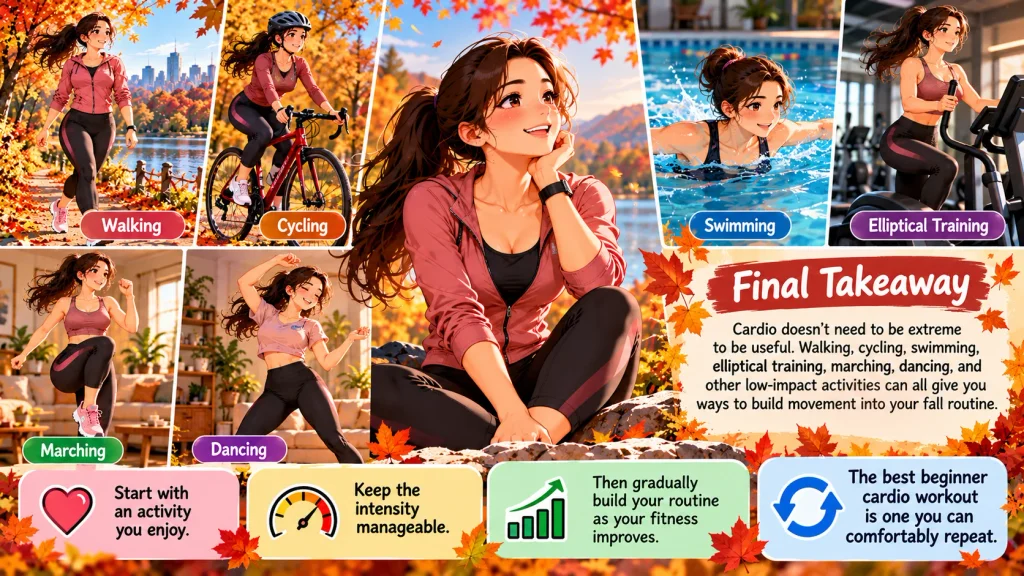
Cardio doesn’t need to be extreme to be useful. Walking, cycling, swimming, elliptical training, marching, dancing, and other low-impact activities can all give you ways to build movement into your fall routine.
Start with an activity you enjoy.
Keep the intensity manageable.
Then gradually build your routine as your fitness improves.
The best beginner cardio workout is one you can comfortably repeat.
FAQs
Brisk walking, cycling, swimming, elliptical workouts, marching, and low-impact circuits are simple cardio options for beginners.
Brisk walking is an accessible starting point, while cycling, swimming, elliptical training, and low-impact aerobic workouts provide other options.
A beginner can start with a manageable session, such as 15–20 minutes, and gradually increase duration as their fitness and comfort improve.
Yes. Brisk walking can raise your heart rate and count as moderate-intensity aerobic activity when performed at an appropriate pace.
Try 5 minutes of easy warm-up, 10 minutes of brisk walking or another low-impact activity, and 5 minutes of easier movement to cool down.
Beginners can spread cardio sessions across the week and gradually work toward recommended levels of regular aerobic activity.
Increase the workout time, slightly increase the pace or resistance, add short intervals, or gradually add another session rather than making every workout intense.